











Quick Service Restaurant (QSR) License & Permit Management Software
Quick service restaurants (QSR) operate at higher unit counts than any other segment of food service. National brands operate 1,000-15,000+ locations through franchisee and corporate networks. Regional QSR operators manage 25-500+ stores. The compliance environment scales accordingly: per-store food permits, business licenses, drive-through authorizations, sign permits, certificate of occupancy, fire safety inspections, FOG compliance, sales tax registrations, and where applicable, alcohol endorsements for QSR locations adding beer/wine service. Multi-state QSR operators face thousands of overlapping renewals annually. This guide explains how QSR operators handle compliance and how Copliancy supports the workflow.
Quick service restaurants face compliance volume that other segments rarely match. Per-store food service licensing, business licenses, drive-through permits, sign permits, certificate of occupancy, fire safety inspections, FOG compliance, and sales tax registrations multiply across hundreds or thousands of stores. The aggregate annual workload runs to thousands of renewals, hundreds of inspections, and ongoing per-store documentation. Multi-state QSR operators face dramatically different rules per state — California county health regimes differ from Texas DSHS, which differs from New York City letter grades, which differ from Florida DBPR. Franchisee operators carry the same compliance burden as corporate operators with the added overlay of franchisor brand standards and required documentation. New store openings concentrate workload — each opening requires coordinated work on 8-15 permits with critical path visibility to opening day. Acquisitions of existing stores (common in franchise consolidation) require integration workflows to bring acquired locations to standardized compliance baseline. Copliancy is used by major QSR operators including Buffalo Wild Wings, Sonic, Applebee’s, Arby’s, Krystal, Jimmy John’s, Baskin-Robbins, Dunkin’, sweetgreen, Panda Express, Chipotle, and many others, supporting per-store license tracking, inspection management, new store opening workflows, and aggregate reporting at scale.
QSR Compliance at Scale
QSR compliance scales differently from other food service segments. Where casual dining or fine dining operates at 5-50 locations, QSR operators routinely operate 100-1,500+ stores. The structural consequences:
- Workload aggregation. 500 stores carrying 8-12 active permits each generate 4,000-6,000 permit records. Annual renewals across the portfolio number in the thousands.
- Inspection density. Health inspections on quarterly or semiannual cycles across 500 stores generate 2,000-4,000 inspection records annually. Tracking citations, remediation, and trends matters.
- Drive-through prevalence. Most QSR brands rely heavily on drive-through. Drive-through permits, traffic management approvals, and operational permits multiply across the portfolio.
- Franchise complexity. Many QSR brands operate primarily through franchisees. Some franchisees operate 50-500+ stores themselves. Franchisor brand standards layer with regulatory compliance.
- New store opening velocity. Growing QSR operators add 10-100+ new stores annually. Each opening requires coordinated permit work.
- Acquisition activity. QSR franchisee consolidation drives frequent acquisitions. Integration workflows must bring acquired stores to consistent compliance baseline quickly.
The QSR Permit Stack
Health department food permit per store. Inspection cycles per jurisdiction (typically quarterly or semiannual for QSR given volume).
City or county business license per store. State sales tax registration. Annual renewal cycle aligned to local fiscal calendar.
Required from city or county building department. Drive-through configuration, dining capacity, kitchen modifications all reflected in CO.
Required in many jurisdictions. Traffic management, queue length restrictions, speaker/menu board approvals.
Pylon signs, monument signs, building signs, menu boards. City sign permits with periodic renewal in some jurisdictions.
Grease trap sizing approvals, pumping records, periodic reporting. Particularly important for QSR with significant fryer use.
Annual fire safety inspection by local fire marshal. Hood suppression system inspection (semiannual). Fire extinguisher service.
Semiannual professional inspection of Ansul or equivalent hood suppression systems above cooking equipment.
For QSR locations adding beer/wine service (an expanding trend in fast-casual and premium QSR). State-specific endorsements with server training requirements.
Franchise vs. Corporate Considerations
QSR operations split between corporate and franchisee structures, each with distinct compliance considerations:
- Franchisor brand standards. National QSR brands maintain standards beyond regulatory minimums — specific food safety protocols, employee training requirements, customer service standards. Franchisees must document compliance with brand standards.
- Franchisor compliance audits. Franchisors conduct periodic audits of franchisee operations. Documentation supports audit findings and resolution.
- License-of-record questions. Some jurisdictions require clarity on whether licenses are held by the franchisee or the franchisor. Documentation matters during transfer events.
- Co-branding complications. Some QSR operators run co-branded stores (Dunkin’ + Baskin-Robbins, KFC + Taco Bell). Compliance for both brands tracked together.
- Master franchisee operations. Master franchisees operating 50-500+ stores themselves run de facto multi-location compliance operations within the franchise structure.
- Acquisition consolidation. Franchisee consolidation through acquisition is one of the biggest QSR trends. Integration of acquired stores requires standardized workflows.
Multi-State QSR Compliance Issues
California county health, Texas DSHS, Florida DBPR, New York DOH, Illinois local health departments — each operates differently. Multi-state QSR operators learn each.
Across 500 stores, citation patterns indicate systemic operational issues. Without aggregate inspection tracking, patterns stay invisible until they become licensing problems.
State-specific renewal cycles (e.g., Florida’s October 1, Ohio’s June 1, California’s rolling) concentrate workload. Bulk renewal workflows matter for QSR scale.
Each opening requires 8-15 permits. Multi-state operators opening 10-100+ stores annually face significant coordination challenge.
Acquiring 25-200 stores in a single transaction is common in QSR consolidation. Integration to consistent compliance baseline takes 6-12 months without dedicated workflows.
FOG requirements vary widely. QSR fryers generate significant grease. Cities with active FOG programs require detailed documentation; cities without don’t.
How Copliancy Handles QSR Compliance
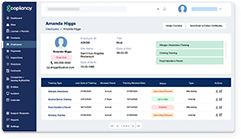
Copliancy is used by major QSR operators including Buffalo Wild Wings, Sonic, Applebee’s, Arby’s, Krystal, Jimmy John’s, Baskin-Robbins, Dunkin’, sweetgreen, Panda Express, Chipotle, and many others. The platform handles QSR-specific scale and complexity:
Hundreds or thousands of stores with complete permit records. Per-store food permit, business license, CO, drive-through, signs, fire safety, FOG all tracked. Aggregate visible across the portfolio.
Health inspections, fire inspections, FOG inspections tracked per store with score history, citations, and remediation. Trend reporting identifies operational patterns.
State-specific concentrated renewals (Ohio June 1, Florida October 1, California rolling, etc.) processed as bulk batches. AP integration aggregates fees for processing.
New store openings tracked through coordinated permit work with critical path visibility to opening day. Repeatable workflows for QSR operators opening 10-100+ stores annually.
When acquiring QSR stores (25-200 in a single deal common), integration workflows inventory existing compliance, identify gaps, and route remediation. Acquired stores reach standardized baseline quickly.
Semiannual hood suppression inspections, annual fire safety inspections, fire extinguisher service all tracked per store with vendor coordination.
Grease trap sizing, pumping schedules, pumping records per store. Compliance ready for city FOG program audits.
For franchisee operators, franchisor reporting and audit support facilitated through structured documentation. Read-only franchisor access configurable where contractually required.
Portfolio reporting across hundreds or thousands of QSR stores — permit status, inspection compliance, citation patterns, new store opening progress. Ready for ownership, board, lender, and franchisor review.
Frequently Asked Questions
Does Copliancy work for QSR operators with 500+ stores?+
Yes. Copliancy is designed for multi-location operators at QSR scale. The platform handles hundreds or thousands of stores with corresponding permit volume. Bulk workflows, aggregate reporting, and integration capabilities matter most at QSR scale.
How does Copliancy handle franchisee operations?+
Franchisee operators with 25-500+ stores have similar compliance needs to corporate operators. Copliancy supports franchisee operations including franchisor-required compliance documentation. Franchisor read-only access to relevant records can be configured where contractually required by franchise agreements.
Can Copliancy support new store opening workflows at scale?+
Yes. New store openings often involve 8-15 separate permits and approvals. Multi-store openings tracked with critical path visibility to opening day. Repeatable workflows support QSR operators opening 10-100+ stores annually.
What about acquisition integration?+
QSR franchisee consolidation drives frequent acquisitions of 25-200 stores. Integration workflows inventory existing compliance, identify gaps, and route remediation. Acquired stores reach standardized compliance baseline through structured workflows.
Does Copliancy handle hood suppression and fire safety for QSR?+
Yes. Hood suppression inspections (semiannual), fire safety inspections (annual), fire extinguisher service all tracked per store with vendor coordination. Service histories preserved for inspector review.
Is Copliancy used by QSR operators today?+
Yes. Major QSR operators including Buffalo Wild Wings, Sonic, Applebee’s, Arby’s, Krystal, Jimmy John’s, Baskin-Robbins, Dunkin’, sweetgreen, Panda Express, Chipotle, and many others use Copliancy for per-store license tracking, inspection management, and aggregate reporting.