











Pennsylvania Liquor License Management: PLCB Compliance for Multi-Location Operators
Pennsylvania operates one of only 17 control states in the United States, where the state itself wholesales and retails wine and spirits through the Pennsylvania Liquor Control Board (PLCB). Restaurants, hotels, and bars in Pennsylvania navigate the unique combination of PLCB-issued licenses, the state’s scarce quota-based restaurant license market (with secondary-market prices reaching $200,000+ in some counties), strict validation requirements, RAMP training (a voluntary PLCB program widely required by operators and insurers), and per-jurisdiction local approvals. Multi-location operators face this complexity at every location and at every renewal. This guide explains how multi-location operators handle PLCB compliance and how Copliancy supports the workflow.
Pennsylvania’s control-state structure makes it one of the most distinct liquor licensing environments in the country. The Pennsylvania Liquor Control Board (PLCB) issues retail licenses, operates state-run wine and spirits stores, and oversees the entire licensing lifecycle — from application through validation, renewal, and transfer. Restaurant (R) licenses are quota-limited per county, creating a secondary market where licenses trade for $50,000 to $200,000+ depending on county. Renewal is biennial but every license must also complete annual validation in between. RAMP (Responsible Alcohol Management Program) is a voluntary PLCB program but widely required by operators and insurers, tracked per location and per server. Multi-location operators face dozens of overlapping renewal and validation deadlines, RAMP recertification cycles, and local approvals (municipal zoning, certificate of occupancy, health permits) layered on top of state requirements. Copliancy is used by Pennsylvania-operating multi-location groups including Bonefish Grill, Carrabba’s, Fleming’s, Outback Steakhouse, Texas Roadhouse, Applebee’s, Buffalo Wild Wings, and others to manage exactly this workflow.
PLCB and Pennsylvania Liquor Licensing Structure
The Pennsylvania Liquor Control Board is the state agency responsible for regulating the manufacture, distribution, and sale of alcoholic beverages in Pennsylvania. PLCB operates differently from most state alcohol agencies in several important ways:
- Control state for wine and spirits. PLCB operates Fine Wine & Good Spirits stores statewide. Restaurant and bar licensees purchase wine and spirits from PLCB stores, not from private distributors.
- Quota-limited restaurant licenses. Restaurant (R) licenses are capped at one per 3,000 population per county. Most counties are at or near quota. New licenses come from inter-county transfers or surrendered licenses.
- Secondary market pricing. Because R licenses are scarce, they trade on a secondary market with prices ranging from $50,000 in less populated counties to $200,000+ in Philadelphia, Allegheny, and Montgomery counties.
- Biennial renewal + annual validation. Licenses renew every two years but require annual validation in the off year — effectively an annual compliance touchpoint.
- Voluntary RAMP program. Responsible Alcohol Management Program is a voluntary PLCB certification but widely required by operators and insurers. Per-location certification with renewal cycles plus per-server training tracked separately.
- Local approval overlay. Municipal approval (zoning compliance, certificate of occupancy, health department certification) required for license issuance and continued operation.
PLCB License Types Multi-Location Operators Track
Full liquor service for on-premise consumption at restaurants. Quota-limited per county. The most common multi-location restaurant license. Biennial renewal with annual validation.
Full liquor service for hotels with required minimum room counts and food service. Different fee structure than R licenses.
Beer-only service at restaurants. Lower entry cost than R license. Common for casual dining concepts.
Private club liquor service. Different operational rules including member-only service restrictions.
Cinemas, theaters, performing arts venues, and similar entertainment locations meeting specific PLCB requirements.
For establishments brewing beer for on-premise consumption. Combines manufacturing and retail authority.
Permits R licensees to sell wine to-go. Significant operational addition since Pennsylvania’s 2016 reforms.
Required for Sunday alcohol service. Annual renewal in addition to base license. Local options apply.
For off-premise catered events with alcohol service. Required for restaurant groups with catering or banquet operations.
Validation and Renewal: The PA Twist
Pennsylvania’s validation system is unique among US states. While licenses technically renew every two years, every license also requires annual validation in the off year:
License Year (Even or Odd Designation)
Every PLCB license is designated as either an “even” year or “odd” year license at issuance. This determines whether renewal occurs in even-numbered or odd-numbered years.
Annual Validation (Off Year)
In the off year, the license must be validated — effectively a mini-renewal that confirms continued qualification. Validation fees apply. Failure to validate triggers license safekeeping or surrender.
Biennial Renewal
Every two years, the license undergoes full renewal with associated fees and documentation requirements. PLCB confirms that local approvals remain current.
Safekeeping (When Locations Close)
If a location closes, the license can be placed in safekeeping with PLCB for up to two years. Safekeeping fees apply. Failure to reactivate or transfer triggers surrender.
Transfer Process
License transfers (intra-county or inter-county) require PLCB approval. Inter-county transfers face additional scrutiny and quota analysis. Process can take 4-9 months.
The practical consequence: every location effectively has a compliance touchpoint every single year, regardless of whether it’s a renewal year or validation year. Multi-location operators must build year-round workflows rather than treating renewal as an episodic event.
RAMP: Voluntary But Widely Required
Responsible Alcohol Management Program (RAMP) is Pennsylvania’s alcohol service training program. RAMP is a voluntary PLCB program, but it’s widely required by employers, insurers, and as a mitigation tool in disciplinary cases. Key requirements:
- Owner/manager training. At least one owner or manager per location must complete RAMP owner/manager training. Per-location certification with two-year cycle.
- Server/seller training. All employees who serve or sell alcohol must complete RAMP server/seller training. Per-employee certification with two-year cycle.
- Signage requirements. RAMP-certified locations must display required signage including responsible service notices and identification check standards.
- Documentation retention. Training certificates must be maintained per employee and produced on demand during PLCB inspections.
- Mitigation in disciplinary cases. RAMP certification can serve as mitigating evidence in PLCB administrative actions against the license, providing a meaningful operational incentive.
Multi-location operators with 200+ alcohol-serving employees across Pennsylvania locations track RAMP as a continuous workflow — new hires getting certified within their grace period, two-year renewals approaching, terminations clearing from active rosters.
Common Pennsylvania Compliance Issues
Operators focused only on biennial renewal miss the off-year validation. License goes into safekeeping or surrender status.
Two-year RAMP cycles spread across hundreds of employees create constant churn. Without per-employee tracking, lapsed certifications surface during PLCB inspections.
Inter-county license transfers take 4-9 months. Operators planning new openings without accounting for transfer time face delayed openings.
WX permits for to-go wine sales require separate renewal. Operators add the permit, then miss renewals because tracking systems don’t separate it from the base R license.
Licenses in safekeeping (after closure) must be activated or transferred within two years. Operators planning to reuse licenses for future locations sometimes miss the deadline.
PLCB conducts proactive underage compliance checks. Failures trigger administrative actions. Per-employee RAMP tracking matters for mitigation.
How Copliancy Handles Pennsylvania Compliance
Each location has a complete record of PLCB license (R, H, E, GP, or other), even/odd year designation, current validation status, and renewal date.
Both annual validation and biennial renewal tracked together. Every license effectively has an annual compliance event, surfaced through proactive alerts.
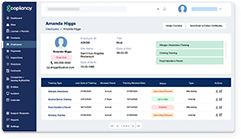
Owner/manager RAMP certifications per location and server/seller RAMP per employee. Integration with HR systems (Workday, ADP, BambooHR, Paychex) keeps employee rosters current.
Municipal zoning compliance, certificate of occupancy, health department permits tracked alongside PLCB licenses. Dependencies surface during validation and renewal.
Licenses in safekeeping (after location closure) tracked with safekeeping start date and two-year deadline. Future reuse plans aligned to deadlines.
WX permits tracked separately from base R licenses with their own renewal cycles. Operators adding to-go wine sales avoid losing the permit at renewal.
Inter-county and intra-county license transfers tracked from purchase agreement through PLCB approval. Critical path visibility to opening date.
Renewal fees, validation fees, and Sunday sales permit fees flow through AP approval workflow. Payment status visible per permit.
Portfolio reporting across Pennsylvania — license status by county, upcoming validations and renewals, RAMP compliance rates, and inspection patterns. Ready for ownership and board review.
Frequently Asked Questions
Does Copliancy file PLCB applications or transfers?+
No. PLCB applications, transfers, and renewals are filed by the operator or licensing counsel through the PLCB+ portal. Copliancy is the internal system of record — tracking applications in progress, capturing resulting licenses, scheduling validations and renewals, and managing the full lifecycle.
How does Copliancy handle the annual validation requirement?+
Each license is configured with its even/odd year designation. The system schedules both biennial renewals and off-year validations as distinct compliance events with their own fees, documentation, and deadlines. Alerts surface 90 days in advance of each.
Can Copliancy track RAMP certifications for hundreds of employees?+
Yes. Server/seller RAMP certifications are tracked per employee with issue date and two-year expiration. Owner/manager RAMP certifications tracked per location. Integration with HR systems keeps employee rosters current as people are hired, transferred, and terminated.
What about Sunday Sales Permits?+
Sunday Sales Permits are tracked separately from base licenses with their own annual renewal cycles. Operators expanding into Sunday service in jurisdictions where the local option permits it add the permit and track it within Copliancy alongside the R license.
Does Copliancy support license transfer tracking?+
Yes. License transfers — intra-county or inter-county — are tracked from purchase agreement through PLCB approval. Documentation, deposits, contingencies, and timing requirements managed through standardized workflow with milestone tracking.
Is Copliancy used by Pennsylvania operators today?+
Yes. Pennsylvania-operating multi-location groups including Bonefish Grill, Carrabba’s, Fleming’s, Outback Steakhouse, Texas Roadhouse, Applebee’s, Buffalo Wild Wings, and many others use Copliancy to manage their Pennsylvania compliance.