











License Management for Convenience Store Chains
Convenience store chains manage some of the most diverse license portfolios in retail — fuel operations, tobacco sales, alcohol sales, lottery and gaming, food service, money services, and standard retail operations all under one roof. Each license category has its own renewal cycle, supporting documentation, and inspection schedule. For chains with hundreds or thousands of stores across multiple states, the cumulative complexity is substantial. This guide explains how convenience store chains manage license compliance at scale and how Copliancy supports the workflow used by major c-store operators.
Convenience store chains manage one of the most diverse license portfolios in retail. Each store typically holds 12-25+ active licenses spanning fuel operations (UST registration, fuel dealer license, vapor recovery, weights and measures, stormwater), tobacco sales (state tobacco license, local tobacco license), alcohol sales (beer/wine license where permitted), lottery and gaming, food service (where prepared food is sold), money services (check cashing, money orders, money transfers), and standard retail (business license, sales tax permit, signage). For multi-state chains, the regulatory variety multiplies — each state’s fuel, tobacco, and alcohol rules are different. Effective c-store compliance requires centralized tracking spanning every category, jurisdiction-specific workflows, employee certification management, fuel-specific environmental compliance, and aggregate reporting. Copliancy handles all of this — used by c-store and small-format retail operators including Allsup’s, Yesway, Inconvenience, Maman NYC, and many more.
The C-Store License Portfolio
A typical convenience store holds a more diverse license portfolio than most full-service retail. The standard universe:
City or county business operating license. Annual renewal typical.
State sales tax registration. Required before selling taxable items.
State motor fuel dealer license for stores selling gasoline or diesel. Annual or biennial renewal.
Underground storage tank registration with state environmental agency. Annual registration plus periodic compliance reporting.
Stage I and Stage II vapor recovery certifications where required. Periodic testing required.
Fuel dispenser certification by state weights and measures. Periodic re-certification (typically annual).
Industrial stormwater compliance for fuel-serving locations. NPDES or state equivalent.
State and local tobacco retail licenses. Includes age-verification compliance and product restrictions.
State alcohol license where permitted. C-store classes vary by state.
State lottery retailer authorization with commission reporting requirements.
Health department permit for stores serving prepared food (sandwiches, hot foods, coffee bar).
State money services business authorization plus federal FinCEN registration for check cashing, money orders, and money transfers.
Local signage permit. Fuel price signs often have specific requirements.
For fuel operations in non-attainment areas. Annual or periodic emissions reporting.
SPCC (Spill Prevention Control and Countermeasure) plans, SARA Tier II reporting, hazmat business plans.
Stores with car washes, ATMs, repair services, or specialty operations add even more licenses on top of this baseline.
Fuel-Specific Compliance
Fuel operations add a regulatory layer that pure retail doesn’t face. Specifically:
Underground Storage Tank Compliance
USTs require ongoing compliance with federal EPA and state regulations: leak detection monitoring, spill prevention, overfill protection, corrosion protection, periodic testing, and annual registration renewal.
Vapor Recovery
Stage I vapor recovery captures vapors when fuel is delivered. Stage II captures vapors when fuel is dispensed. Required in certain non-attainment areas. Periodic testing required.
Weights and Measures Certification
Fuel dispensers must be calibrated and certified by state weights and measures. Inaccurate dispensers — either short-dispensing (customer harm) or over-dispensing (operator loss) — generate violations.
Stormwater Compliance
Fuel-serving sites generate runoff that can carry petroleum residue. NPDES or state-equivalent permits require stormwater pollution prevention plans, training, and periodic inspections.
SPCC Plans
Spill Prevention Control and Countermeasure plans are required for facilities with significant petroleum storage. Plans must be updated periodically and on changes.
Hazmat Reporting
SARA Tier II hazardous chemical inventory reports are due annually. Hazardous Materials Business Plans are required in some states.
Fuel Quality and Octane
Some states require periodic fuel quality testing. Octane labeling must match actual fuel.
State Variation
C-store regulation varies dramatically by state. Some examples:
- Alcohol Sales. Some states allow beer/wine sales at convenience stores; others restrict or prohibit.
- Tobacco Restrictions. Some jurisdictions impose distance restrictions from schools, flavored tobacco bans, or minimum-age increases.
- Lottery and Gaming. Some states allow lottery only. Some allow VLT (video lottery terminals). Restrictions vary.
- Fuel-Specific Rules. California’s CARB rules differ substantially from Texas TCEQ rules. Vapor recovery requirements vary.
- Money Services Thresholds. MSB registration thresholds and ongoing compliance obligations vary by state and product.
Multi-state c-store chains must maintain detailed knowledge of every state where they operate — and translate that knowledge into store-specific compliance workflows.
A C-Store License Tracking Workflow
-
1
Inventory Every License, Every Store
For each store, document every active license — fuel, tobacco, alcohol, lottery, food, MSB, environmental. Tag with jurisdiction and supporting documentation.
-
2
Track Environmental Records Separately
UST registration, vapor recovery certifications, stormwater permits, SPCC plans, SARA Tier II reports — each tracked on its own cycle with periodic compliance reporting deadlines.
-
3
Manage Employee Certifications
Food handler cards, alcohol service certifications, money services compliance training (AML), responsible vendor training — track at the employee level.
-
4
Configure Multi-Stage Renewal Notifications
Renewal alerts fire at 90, 60, 30, and 7 days before expiration. Notifications route to district managers, corporate compliance, and finance.
-
5
Track Inspections Across Categories
Weights and measures inspections, health inspections, fuel quality testing, vapor recovery testing, tobacco compliance checks, alcohol compliance checks — all logged with findings.
-
6
Aggregate Corporate Reporting
Corporate compliance sees the entire portfolio with exception reports for upcoming renewals, recent violations, and at-risk records.
How Copliancy Supports C-Store Operations
Comprehensive License Tracking
Fuel licenses, environmental permits, tobacco, alcohol, lottery, food service, money services, hazmat, and standard retail licenses all live in one platform with structured records and renewal workflows.
Fuel-Specific Modules
UST registration, vapor recovery, weights and measures, stormwater, SPCC, and SARA Tier II reporting can all be tracked with their specific compliance requirements and periodic reporting deadlines.
Employee Certification Integration
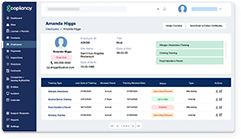
Food handler certifications, alcohol service training, AML training for money services, and other employee credentials are tracked at the individual level through Copliancy’s employee module — with HR, POS, and scheduling system integration.
Jurisdiction-Specific Workflows
Renewal timing, documentation, and notification routing are configured per jurisdiction. Multi-state c-store chains handle 50-state regulatory variety in one platform.
Inspection and Violation Tracking
Health inspections, weights and measures inspections, fuel quality testing, vapor recovery testing, tobacco compliance checks, and alcohol compliance checks are all logged with findings and remediation tracking.
Document Storage
License certificates, environmental compliance documents, training records, inspection reports, and supporting documentation live in one platform with SharePoint and Dropbox integrations.
Site Due Diligence and Development
For new c-store openings (or acquisition of existing stores), Copliancy guides operators through due diligence and development until each store is operational.
Bulk Operations
Bulk Update and Bulk Renewal processes save substantial time for chains managing hundreds or thousands of stores.
C-Store and Small-Format Retail Operators Using Copliancy
Copliancy is used by c-store and small-format retail operators including Allsup’s, Yesway, Inconvenience, Maman NYC, World Market, The Fresh Market, Lidl, Heritage Grocers, Associated Food Stores, Meijer, and many more multi-location retail operators with diverse compliance needs.
Frequently Asked Questions
Can Copliancy handle UST and environmental compliance alongside operational licensing?+
Yes. UST registration, vapor recovery certifications, stormwater permits, SPCC plans, SARA Tier II reports, and other environmental compliance records are tracked alongside operational licenses (fuel dealer, tobacco, alcohol, lottery). The platform handles the full c-store compliance portfolio rather than requiring separate environmental tools.
How does Copliancy handle multi-state c-store operations?+
Each store’s licenses are tagged with their issuing jurisdiction. State-specific renewal workflows, documentation requirements, and reporting obligations are configured per state. Multi-state chains handle 50-state regulatory variety in one platform rather than maintaining separate tools per state.
Can Copliancy track money services compliance for c-stores offering check cashing or money transfers?+
Yes. State Money Services Business (MSB) authorization, federal FinCEN registration, AML compliance documentation, and related employee training are all tracked. Currency Transaction Reports (CTRs) and Suspicious Activity Reports (SARs) follow defined workflows.
How does Copliancy handle weights and measures certifications for fuel dispensers?+
Fuel dispenser certifications are tracked as periodic records with re-certification scheduling. State inspector visits and certification renewals fire on the appropriate cadence. Dispenser-by-dispenser records allow tracking of individual equipment status.
Can Copliancy support tobacco compliance checks and age verification programs?+
Tobacco compliance inspections (both state-conducted and internal mystery shopper programs) are logged with findings and remediation tracking. Age verification training for employees is managed through the employee certification workflow. Repeat tobacco violations escalate to corporate compliance for additional intervention.
Does Copliancy support c-store acquisitions and conversions?+
Yes. When acquiring stores from another operator, Copliancy’s site due diligence and development workflow guides operators through the conversion process — transferring licenses where possible, applying for new licenses where required, and onboarding the stores into the broader portfolio.