











License Compliance Software for Franchise Networks
Franchise networks face a unique compliance challenge: the corporate office is responsible for brand standards and overall regulatory exposure, but individual franchisees own and operate their own locations — with their own permits, their own renewals, and their own audit risk. When a franchisee lets a liquor license lapse, the corporate brand takes the hit. When a franchisee racks up health violations, the corporate brand takes the hit. This guide explains how franchise networks centralize license compliance visibility across hundreds or thousands of franchisee-operated locations using Copliancy.
Franchise networks operate under a unique compliance dynamic: the corporate office is responsible for the brand and its overall regulatory standing, but individual franchisees own the licenses and permits at each location. When a franchisee lets a liquor license lapse, accumulates health violations, or fails to display required permits, the corporate brand takes the reputational and regulatory hit even though the franchisee is technically responsible. Effective franchise compliance requires centralized corporate visibility into every franchisee’s license status, structured franchisee self-service so each operator manages their own renewals without burdening corporate, role-based access that respects ownership boundaries, exception-based reporting that flags risk before it becomes a brand problem, and standardized workflows so franchisees can’t go rogue with their compliance approach. Copliancy delivers all of this — used by franchise brands and networks including Dunkin’, Arby’s, Sonic, Baskin-Robbins, Inspire Brands, Buffalo Wild Wings, Jimmy John’s, Applebee’s, Krystal, and many more.
The Franchise Compliance Challenge
Franchise networks present a fundamentally different compliance problem than corporate-owned multi-location operators. In a corporate-owned model, every location reports up through a single chain of command — compliance, ops, and finance are all coordinated through corporate. In a franchise model, each franchisee is an independent business owner running their own operations, with their own staff, their own bank account, and their own legal entity.
For licenses and permits, the practical reality is:
- The franchisee — not the corporate franchisor — typically holds the operational licenses (business license, health permit, liquor license, occupancy permit, etc.)
- The franchisee pays for renewals out of their own funds
- The franchisee schedules and responds to inspections
- The franchisee is the legal entity in violation if a license lapses
But the brand consequences flow up to the franchisor:
- News stories about shuttered locations name the brand, not the franchisee
- Reviews highlighting health code violations damage the brand reputation
- Class-action lawsuits often name the franchisor as a co-defendant
- Regulators view franchisor oversight as part of their inquiry when systemic issues emerge
This creates an uncomfortable middle ground. The franchisor doesn’t own the license obligations but bears the brand consequences. The franchisor can’t directly manage renewals but is held accountable when renewals fail.
Corporate vs Franchisee Roles
Effective franchise compliance starts with clarity about who owns what. A reasonable model:
| Responsibility | Franchisor (Corporate) | Franchisee |
|---|---|---|
| Maintain license records | Visibility into status | Direct ownership of records |
| File renewals | Reminders and oversight | Direct responsibility |
| Pay renewal fees | — | Direct payment from operating account |
| Schedule and respond to inspections | — | Direct responsibility |
| Manage violations and remediation | Visibility into patterns | Direct remediation |
| Aggregate compliance reporting | Owned at corporate level | — |
| Brand standards enforcement | Set by corporate | Enforced at location |
The trick is making this clean separation actually work in software. Without the right platform, franchisors end up with two equally bad options:
- No visibility. Each franchisee runs their own spreadsheets and never reports up. Corporate finds out about lapses when news articles or regulator notices arrive.
- Heavy corporate involvement. Corporate becomes the help desk, processing renewals on behalf of franchisees and absorbing costs that should sit with the operator.
The Visibility Model That Works
The model used by mature franchise networks gives corporate centralized visibility without taking over franchisee operations. Specifically:
Franchisee-Owned Records
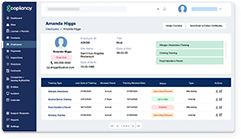
Each franchisee maintains their own license records inside the shared platform. They own the renewals, the documents, the payment workflows, and the inspection responses. Corporate doesn’t touch the day-to-day.
Corporate-Level Read Access
The corporate compliance team has read-only visibility into every franchisee’s license status across the network. They can see expirations coming up, identify franchisees with recurring violations, and spot systemic issues before they become brand problems.
Exception-Based Reporting
Instead of corporate reviewing every renewal across thousands of locations, exception reports surface the situations that need attention: licenses expiring in 30 days with no renewal action filed, franchisees with multiple inspection violations in a rolling period, locations with display compliance gaps. Corporate intervention is targeted, not constant.
Standardized Workflows
Franchisees follow the same renewal workflow regardless of franchisee or location. Reminder timing, document checklists, and notification routing are standardized. This means franchisor onboarding for new franchisees is consistent, and a franchisee shifting between markets faces the same workflow they already know.
Brand-Wide Reporting
The corporate compliance team can produce reports across the entire network — “show me every liquor license expiring in the next 90 days across all franchisees” — without manually pulling data from each franchisee’s records.
Common Risk Scenarios Franchise Networks Face
The lapsed liquor license
A franchisee in a secondary market doesn’t track liquor renewals carefully. The license lapses for 30 days. State ABC issues a violation. The franchisee restarts the application process, but during that time the location can’t serve alcohol. Local news picks up the story — using the brand name, not the franchisee’s name. Sales drop across the region as customers question other locations.
The violation pattern
A single franchisee with three locations racks up a series of health violations across all three over six months. No single violation is severe, but the pattern indicates an underlying operational issue. By the time corporate notices, the regulator has already opened a broader inquiry into franchisor oversight.
The expired display
A franchisee renews their permit on time but never posts the new permit at the location. The expired permit stays on the wall for months. An inspector arrives unannounced, sees the expired permit, and writes a violation — even though the underlying permit is actually current. Easy violation, easy revenue hit, easy embarrassment.
The new-location stall
A franchisee signs a new location lease but doesn’t complete the licensing checklist before opening. The location opens without one or more required permits, takes a citation, has to pay fines, and faces extended scrutiny on every subsequent renewal.
How Copliancy Handles Franchise Networks
Multi-Tenant Architecture
Copliancy supports franchise networks through a multi-tenant model where each franchisee maintains their own records inside the broader platform, and corporate gets aggregated visibility across the network.
Role-Based Access
Permissions are configured per role: franchisees have full edit access to their own records, location managers have read-only access for their own location, corporate compliance has read-only visibility across the network, and corporate operations leaders see aggregate reports without individual record edit rights.
Automated Renewal Notifications
Each franchisee receives notifications for their own license renewals — at 90, 60, 30, and 7 days before expiration. Notifications stay with the franchisee unless they reach the escalation point, at which case corporate gets visibility too.
Document Storage
Franchisees store their own license documents in the platform, with SharePoint and Dropbox integrations. Corporate has read access to verify documents exist and are current.
Site Due Diligence and Development
For new franchisee openings, Copliancy guides through the due diligence and development of new sites until they are operational — providing a standardized opening checklist regardless of franchisee or market.
Inspection and Violation Tracking
Franchisees log their own inspections and remediation actions. Corporate sees aggregate patterns: which franchisees have recurring violations, which locations have unresolved findings, which markets are seeing regulator pressure.
Brand-Wide Reporting
Corporate compliance generates reports across the entire network — by franchisee, by market, by license type, by jurisdiction — without requiring data extraction from each franchisee individually.
Franchise Brands and Networks Using Copliancy
Copliancy is trusted by franchise networks and franchise brands including Dunkin’, Arby’s, Sonic, Baskin-Robbins, Inspire Brands, Buffalo Wild Wings, Jimmy John’s, Applebee’s, Krystal, Bloomin’ Brands, Outback Steakhouse, Carrabba’s Italian Grill, Bonefish Grill, Fleming’s Prime Steakhouse, BJ’s Restaurants, Texas Roadhouse, Red Robin, Chipotle, sweetgreen, Panda Express, Cooper’s Hawk, Lidl, Allsup’s, Yesway, World Market, The Fresh Market, Meijer, Heritage Grocers, Associated Food Stores, Inconvenience, Snooze Eatery, Topgolf, Drive Shack, Round One Bowling & Arcade, Go Ape, Alamo Drafthouse Cinema, American Golf, Wedgewood Weddings, and many more.
Frequently Asked Questions
Who owns the license records in a franchise model — the franchisor or the franchisee?+
Legally, the licenses themselves are held by the franchisee (the operating entity at each location). In Copliancy’s model, the franchisee maintains direct edit access to their own records, while corporate has read-only visibility for oversight and aggregate reporting. This respects the legal ownership while giving the franchisor the brand-level visibility they need.
How does Copliancy prevent corporate from becoming a help desk for franchisees?+
Franchisees are configured with full self-service access to their own records — they file their own renewals, upload their own documents, manage their own payments, and respond to their own inspections. Corporate intervention is triggered only when exception reporting flags an issue (renewal not filed close to expiration, multiple violations in a rolling period, etc.) rather than corporate manually reviewing every record.
Can different franchisees have different workflows?+
Workflows are standardized at the brand level for consistency — same reminder timing, same document requirements, same escalation rules. This ensures franchisees follow consistent practices across the network. Brand-specific customization is configured at the franchisor level, not the franchisee level.
What if a franchisee operates multiple locations?+
Many franchisees own multiple locations within a brand. In Copliancy, each location’s records sit under the franchisee’s organization, and the franchisee has visibility across all their own locations. Corporate sees the franchisee as a unit and can roll up reporting at the franchisee level or drill down to individual locations.
How does Copliancy handle new-location openings for franchisees?+
Copliancy guides franchisees through the due diligence and development of new sites until they are operational. The platform provides a standardized opening checklist for the brand, ensuring every franchisee follows the same licensing workflow for new locations regardless of market.
Can corporate require certain documents or workflows for franchisees?+
Yes. Brand-level requirements (required licenses, document checklists, renewal lead times, inspection responses) are configured at the corporate level and applied to all franchisees. This ensures consistent practices across the network without requiring corporate to micromanage individual franchisees.