











Healthcare Facility Licensing & Compliance Software
Healthcare facilities operate under one of the most complex regulatory environments of any industry: state facility licensing, federal Medicare and Medicaid certification, accreditation requirements (Joint Commission, AAAHC, DNV), DEA registration, CLIA certification for labs, controlled substance authorization, HIPAA compliance documentation, and dozens of professional licenses for individual practitioners. For multi-facility healthcare operators — clinic networks, ambulatory surgery centers, urgent care groups, dental groups, dialysis providers — managing this portfolio at scale requires purpose-built systems. This guide explains the healthcare compliance landscape and how Copliancy supports the workflow.
Healthcare facilities operate under one of the most complex compliance environments of any industry. A single ambulatory surgery center, urgent care, dental practice, or specialty clinic might maintain state facility licensing, federal Medicare/Medicaid certification, accreditation (Joint Commission, AAAHC, DNV, or specialty-specific bodies), DEA registration for controlled substances, CLIA certification for laboratory operations, individual licenses for every provider and certain clinical staff, plus state-level controlled substance authorization, X-ray equipment registration, and dozens of supporting compliance documents. For multi-facility healthcare operators, this portfolio multiplies across every location. Effective healthcare compliance requires centralized tracking spanning facility-level and individual-level records, accreditation and survey readiness workflows, controlled substance audit-readiness, jurisdiction-specific renewal automation, and aggregate corporate visibility. Copliancy supports this complexity with its license and permit management platform, contract management, equipment tracking, inspection workflows, and employee training integration.
The Healthcare Regulatory Landscape
Healthcare compliance operates simultaneously across federal, state, and accreditation layers. Each governs a different aspect of the facility’s operations:
Federal Layer
- Medicare Certification (CMS): Required for facilities billing Medicare. Includes Conditions of Participation specific to facility type.
- Medicaid Certification: Administered by states but with federal baseline requirements.
- DEA Registration: Required for facilities prescribing or dispensing controlled substances. Renewed every 3 years.
- CLIA (Clinical Laboratory Improvement Amendments): Required for labs performing diagnostic testing on humans. Three certificate types based on test complexity.
- HIPAA: Ongoing compliance with privacy, security, and breach notification rules.
- OSHA: Bloodborne pathogens, hazard communication, ergonomics, workplace safety.
- FDA: For facilities handling specific regulated products (e.g., compounded pharmacy, certain devices).
State Layer
- State Facility License: Issued by state department of health. Required to operate. Specific license type varies by facility (hospital, ambulatory surgery center, urgent care, dental, dialysis, etc.).
- State Controlled Substance Authorization: State-level authorization to handle controlled substances, on top of federal DEA registration.
- X-Ray Equipment Registration: State health department registration for imaging equipment.
- Pharmacy License: For facilities operating in-house pharmacies.
- State Lab Certification: Some states have their own lab certification on top of federal CLIA.
- State Sales/Use Tax: For facilities selling taxable items (e.g., retail products, certain procedures).
Accreditation Layer
- Joint Commission: Most common hospital and ASC accreditation.
- AAAHC (Accreditation Association for Ambulatory Health Care): Common for ambulatory surgery centers, primary care, and specialty clinics.
- DNV Healthcare: CMS-deemed status alternative to Joint Commission.
- Specialty-Specific: ACS NSQIP, ACR for radiology, NCQA for managed care, etc.
Individual Practitioner Layer
Every provider holds their own individual licenses — state medical license, DEA registration, controlled substance authorization, specialty board certifications, hospital privileges. These are tracked separately from facility licensing but tie back to facility operations.
Facility License Categories
Annual or biennial renewal. Includes survey/inspection by state health department. Required for operation.
Survey-based certification with no fixed renewal date. Re-survey typically every 3 years (varies by facility type). Required for Medicare billing.
3-year renewal cycle. Required for prescribing or dispensing controlled substances. Schedule-specific (Schedule II vs III-V).
2-year renewal cycle. Three types: Waiver (CLIA-waived tests only), Provider-Performed Microscopy, Compliance/Accreditation (moderate or high complexity).
State-specific renewal cycles (annual to 3-year). Required in addition to federal DEA registration.
State health department registration for imaging equipment. Annual or biennial renewal. Per-machine documentation required.
For in-house pharmacy operations. State board of pharmacy licensing plus pharmacist-in-charge documentation.
3-year survey cycle most common (Joint Commission). Continuous compliance with standards between surveys.
Accreditation Readiness
Healthcare accreditation is fundamentally different from typical license renewal. Most licenses follow a “submit application, pay fee, get renewed” pattern. Accreditation follows a “demonstrate continuous compliance through on-site survey” pattern.
The accreditation cycle typically runs three years between major surveys, but surveys can occur unannounced (Joint Commission’s “unannounced survey” approach is now standard). Continuous compliance with hundreds of standards is required between surveys. Facilities that treat accreditation as a periodic event rather than a continuous practice struggle when surveyors arrive.
What surveyors look at:
- Patient care and infection control practices
- Medication management protocols
- Environment of care (equipment, facility, safety)
- Emergency management and disaster preparedness
- Human resources documentation (credentialing, training, competencies)
- Performance improvement programs
- Information management and patient privacy
- Leadership and governance structures
The practical implication: facilities need continuous documentation systems that capture compliance with each standard. When the surveyor asks “show me your competency assessments for the last 12 months,” the answer needs to be a one-click export from an organized system — not a frantic search through binders.
Individual Practitioner and Staff Licenses
Healthcare facilities don’t just hold facility-level licenses. They also depend on dozens or hundreds of individual licenses held by providers and clinical staff:
- State Medical License: Each physician renews their state medical license (typically annual or biennial). Renewals require continuing medical education (CME) credits.
- DEA Registration: Each prescribing provider holds their own DEA registration.
- State Controlled Substance Authorization: Provider-level state authorization in addition to federal DEA.
- Board Certification: Specialty board certification with continuous certification requirements (CME, periodic re-certification exams).
- Nursing Licenses: RN, LPN, NP licenses with state-specific renewal cycles and CE requirements.
- Allied Health Licenses: Pharmacist, pharmacy technician, radiology technician, respiratory therapist, etc.
- Hospital Privileges: Where applicable, hospital-granted privileges with periodic re-credentialing.
Facility operations depend on every required clinical role holding current licenses. When a provider’s license lapses, they can’t see patients in that state. When a pharmacist’s license lapses, the pharmacy can’t operate.
Multi-Facility Healthcare Operations
For healthcare networks operating multiple facilities — clinic networks, ASC chains, urgent care groups, dental groups, dialysis providers — every dimension of compliance multiplies. A 25-facility network might be managing:
- 25 state facility licenses across multiple states
- 25 CMS certifications
- 25 DEA registrations
- 25 CLIA certificates (if labs operate)
- 25 accreditation cycles
- Hundreds of individual provider licenses
- Thousands of supporting compliance documents (policies, protocols, training records)
Without centralized tracking, each facility becomes a compliance island. When a corporate compliance officer needs to verify accreditation readiness across the network, the answer requires manual data extraction from every facility. When a license lapses at one facility, corporate finds out from the state, not from internal monitoring.
How Copliancy Supports Healthcare Operations
Facility License Tracking
State facility licenses, CMS certifications, DEA registrations, CLIA certificates, state controlled substance authorizations, X-ray registrations, and pharmacy licenses are all tracked as structured records with renewal workflows, supporting documentation, and audit-ready exports.
Individual License Management
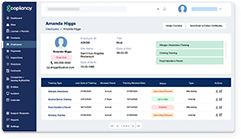
Provider and clinical staff licenses can be managed through Copliancy’s employee compliance module, integrating with HRIS systems for automatic enrollment and termination. CME tracking, board certification status, and DEA renewals are supported.
Accreditation Documentation
Policies, protocols, training records, competency assessments, performance improvement documentation, and other survey-readiness records are stored centrally with version control and audit trail.
Equipment and Maintenance Tracking
Healthcare equipment — imaging machines, sterilization equipment, autoclaves, infusion pumps, AED units — requires regular maintenance, calibration, and documentation. Copliancy’s equipment and repair management module handles preventive maintenance schedules, repair history, and equipment-specific compliance records.
Contract Management
Medical director agreements, group purchasing organization (GPO) contracts, EHR vendor contracts, business associate agreements (BAAs), and other healthcare-specific contracts live alongside the license records.
Inspection and Survey Tracking
State health department surveys, CMS validation surveys, accreditation surveys, and other on-site inspections are logged with findings and remediation tracking. Cross-facility patterns surface for corporate compliance teams.
Incident Reporting
Patient incidents, employee incidents, equipment incidents, and security incidents can all be reported and tracked through Copliancy’s incident reporting and insurance claims management module — integrated with the broader compliance workflow.
Multi-Facility Visibility
Corporate compliance teams have aggregate visibility across every facility. Exception reports flag facilities with upcoming renewals, recent survey findings, or expired individual provider licenses. Bulk operations support efficient management of large portfolios.
Frequently Asked Questions
Can Copliancy handle multi-state healthcare operations?+
Yes. Each facility’s licenses are tagged with their issuing state, with state-specific renewal workflows, documentation requirements, and survey schedules. Multi-state healthcare operators handle 50-state regulatory variety in one platform rather than maintaining separate tools per state.
Does Copliancy track individual provider licenses, not just facility licenses?+
Yes. Provider licenses (medical license, DEA registration, state controlled substance authorization, board certification) can be tracked through Copliancy’s employee compliance module. CME credit tracking, hospital privileges, and credentialing documentation are supported.
How does Copliancy support accreditation readiness?+
Accreditation readiness is fundamentally about continuous documentation of compliance with standards. Copliancy stores policies, protocols, training records, competency assessments, performance improvement documentation, equipment maintenance records, and incident records — all in one platform with version control and audit trail. When surveyors request documentation, the response is a one-click export rather than a binder search.
Can Copliancy handle pharmacy operations within a healthcare facility?+
Yes. Pharmacy licensing, pharmacist-in-charge documentation, controlled substance security records, immunization protocols, and individual pharmacist and pharmacy technician licenses can all be tracked. Federal DEA registration and state controlled substance authorization are managed alongside the facility license.
Does Copliancy handle HIPAA compliance documentation?+
Copliancy stores HIPAA-related compliance documentation — policies, procedures, training records, risk assessments, breach notification documentation, and business associate agreements. The platform doesn’t itself process protected health information; it manages the compliance documentation surrounding HIPAA programs.
What about CLIA certification for in-facility labs?+
CLIA certificates are tracked as structured records with renewal workflows. The certificate type (waiver, PPM, compliance/accreditation) is captured in metadata. Renewal cycles, proficiency testing requirements, and supporting documentation are managed through the platform.