











Health Permit Tracking for Multi-Location Restaurants
Health permits are the most operationally critical permit in food service. An expired health permit means immediate closure — not a fine, not a warning, but a forced shutdown until the issue is resolved. For restaurant groups operating across multiple cities, counties, and states, health permit tracking gets complicated fast: each jurisdiction issues its own permits, on its own renewal cycle, with its own inspection schedule. This guide explains how multi-location restaurant operators track health permits at scale, the common failure points, and how Copliancy automates the workflow used by national restaurant brands.
Health permits are the highest-stakes operational documents in food service — an expired permit means immediate closure of a location, not a warning or fine. For multi-location restaurant operators, health permit tracking is complicated by jurisdictional fragmentation: every city, county, and state issues its own permits with its own renewal cycle, fee structure, inspection schedule, and documentation requirements. A 100-location restaurant group might be tracking 100+ unique health permit configurations. Manual tracking breaks down predictably. Effective health permit management requires centralized records with jurisdiction-specific metadata, automated renewal notifications, document storage for permit certificates and inspection reports, violation tracking with remediation workflows, role-based access for general managers, and recurring compliance display checks. Copliancy handles all of this — used by national restaurant operators including Outback Steakhouse, Buffalo Wild Wings, Chipotle, Texas Roadhouse, sweetgreen, Panda Express, Jimmy John’s, and many more.
What Health Permits Cover
Health permits are government-issued authorizations from public health departments allowing a business to operate food service. The specific name varies — food service permit, food establishment permit, food handler permit, health department certification — but the underlying requirement is the same: pass an inspection, pay a fee, and renew on a regulator-defined cycle to keep your doors open.
Health permits typically govern:
- Food safety and sanitation standards
- Temperature controls for cold storage and hot holding
- Cross-contamination prevention
- Employee hygiene and food handler certifications
- Pest control documentation
- Equipment and surface cleanliness
- Water quality and waste handling
- Allergen and labeling controls
For most restaurants, health permits are renewed annually, though some jurisdictions use biennial cycles. Inspections happen separately — most jurisdictions run scheduled inspections one to four times per year, plus unannounced visits triggered by complaints or violation history.
Jurisdictional Complexity at Scale
The reason health permit tracking gets hard for multi-location restaurant groups isn’t volume — it’s variation. Each jurisdiction handles permits differently, and a national restaurant operator touches dozens or hundreds of unique configurations.
In some areas, health permits are issued by the city; in others by the county; in a few by the state. The same restaurant chain operates under different layers in different markets.
Some jurisdictions require renewal 60 days before expiration. Others won’t accept renewals more than 30 days out. Some auto-renew with payment; others require pre-renewal inspection.
High-volume operators in some markets get inspected quarterly. In others, annually. Inspection scores are public in some jurisdictions and posted at the storefront.
Health permit fees range from under $100 to over $1,000 per location depending on jurisdiction, restaurant type, and capacity. Multi-permit operators often have hundreds of distinct fee structures to manage.
Some renewals require updated floor plans. Others require certified food protection manager documentation. Others require recent pest control records. The list isn’t consistent.
Some jurisdictions require the current permit posted at the entrance. Some require inspection scores posted. Others require permits behind the counter. Mistakes here generate easy violations.
Inspections and Violations
Health permits are inseparable from inspections. The permit grants authorization to operate; the inspections verify ongoing compliance with the conditions of the permit. For multi-location operators, inspection management is the other half of health permit operations.
How inspections typically flow
An inspector arrives (usually unannounced for high-volume operators). The inspector walks the kitchen, checks food storage temperatures, reviews documentation, inspects equipment, and observes employee practices. Each finding is logged as either a critical (high-risk) violation, a major violation, or a minor violation. The inspector issues a written report and often a numeric score that gets posted publicly.
Where it goes wrong
- Violations aren’t centrally tracked. Each inspection report ends up in the location manager’s filing cabinet — or worse, on a clipboard that gets lost. When patterns emerge across locations, nobody sees them.
- Remediation isn’t enforced. Inspectors require corrections to be completed within a specific window (often 10-30 days). Without a tracking system, follow-up inspections find the same violations unfixed.
- Repeat violations escalate. Jurisdictions track violation history. Repeat violations result in higher penalties, more frequent inspections, and potential permit suspension.
- Public scores aren’t managed. Many jurisdictions publish inspection scores online or require posting at the storefront. Poor scores affect revenue directly — and rebuilding a score takes multiple consecutive clean inspections.
A Health Permit Tracking Workflow That Scales
Multi-location restaurant operators use a structured workflow combining permit tracking with inspection management. The workflow:
-
1
Inventory Every Permit Across the Portfolio
Document each location’s health permit: jurisdiction (city, county, state), permit number, issuing authority, expiration date, fee, renewal window, posted location, and current permit photo. Add jurisdiction-specific metadata: inspection frequency, scoring system, public display rules.
-
2
Configure Jurisdiction-Specific Renewal Workflows
Renewal timing, document checklists, and payment workflows are configured per jurisdiction. Generic schedules don’t work because health departments don’t operate on a uniform calendar.
-
3
Track Supporting Documents on Their Own Cycles
Certified food protection manager certifications, pest control contracts, food handler cards — all expire on their own schedules. Track each as a separate record so health renewals always have the supporting documents they need.
-
4
Log Every Inspection With Findings
Every inspection — scheduled or unannounced, passed or failed — is logged in the system with the inspector’s name, the date, the score, and every finding noted. Findings become tasks with assigned owners and remediation deadlines.
-
5
Track Remediation to Completion
Each finding has a remediation deadline. The platform fires reminders as deadlines approach. When the remediation is completed (with documentation), the task closes.
-
6
Surface Cross-Location Patterns
When the same violation appears across multiple locations, that’s a systemic issue requiring an operations response — not just a location-by-location fix. Centralized tracking surfaces those patterns automatically.
-
7
Give GMs Self-Service Access
When inspectors arrive, general managers need their current permit, recent inspection reports, and food handler documentation in seconds — not a Slack message to corporate.
How Copliancy Automates Health Permit Tracking
Copliancy is purpose-built for the workflow above. Specifically:
Permit Tracking
Every health permit is stored as a structured record with permit number, issuing authority, expiration date, renewal notice date, payment history, and the actual permit document — accessible in seconds. Pending applications are tracked separately from active permits; when an application is approved, Copliancy automatically promotes the record to active status.
Jurisdiction-Specific Workflows
Different jurisdictions get different renewal lead times, document checklists, and notification routing. The complexity of multi-state, multi-county operations is handled inside the platform rather than forced onto compliance staff.
Inspection and Violation Tracking
Copliancy includes a dedicated inspection and violation tracking module. Inspections are logged with findings; violations become tasks with assigned owners and remediation deadlines. Repeat violations are flagged. Cross-location patterns become visible in aggregate reports.
Document Storage and Integration
Permit certificates, inspection reports, pest control records, food handler certifications, and food protection manager documentation are all stored in one place. Integrations with SharePoint and Dropbox ensure documents are never lost.
Automated Renewal Notifications
Multi-stage notifications fire at 90, 60, 30, and 7 days before each health permit expiration. Notifications route to multiple recipients with escalation rules if action isn’t taken.
Bulk Renewal Processing
For groups with dozens or hundreds of locations, Copliancy’s bulk renewal feature processes renewals across multiple locations in one workflow.
Payment Tracking
Generate check requests, integrate with accounts payable, associate line items for fees, and run approval workflows. Payment status is tracked against renewal deadlines.
Compliance Display Checks
Recurring automated checks verify the current health permit and inspection score are displayed at the location per jurisdiction-specific rules.
Restaurant and Food Service Operators Using Copliancy
Copliancy is trusted by multi-location restaurant and food service operators including Outback Steakhouse, Buffalo Wild Wings, BJ’s Restaurants, Texas Roadhouse, sweetgreen, Panda Express, Jimmy John’s, Chipotle, Applebee’s, Logan’s, Dunkin’, Arby’s, Sonic, Baskin-Robbins, Inspire Brands, Bloomin’ Brands, Cooper’s Hawk, Cooper’s Hawk Winery, Snooze Eatery, Carrabba’s Italian Grill, Bonefish Grill, Fleming’s Prime Steakhouse, Bubba Gump Shrimp Co, Landry’s, Saltgrass Steak House, Morton’s The Steakhouse, McCormick & Schmick’s, Del Frisco’s Double Eagle Steakhouse, Del Frisco’s Grille, Chart House, Bar Louie, Joe’s Crab Shack, RA Sushi, Kona Grill, STK Steakhouse, Sullivan’s Steakhouse, Eddie Merlot’s, Red Robin, Brio, Bravo, Bertucci’s, Earl Enterprises, Buca di Beppo, TooJay’s, King Ranch Texas Kitchen, Benihana, Krystal, Citizens Kitchen and Bar, and many more.
Frequently Asked Questions
What happens if a health permit expires?+
Most jurisdictions treat an expired health permit as an immediate closure requirement. The location must cease food service operations until the permit is renewed and the location passes any required re-inspection. Late renewal fees apply, and the renewal may require restarting parts of the application process. For high-volume restaurants, even a one-day closure costs thousands in lost revenue.
How does Copliancy handle the difference between city, county, and state permits?+
Each permit is tagged with its issuing jurisdiction, and jurisdiction-specific metadata is stored with the record — renewal window, fee structure, inspection schedule, posted display requirements, and supporting documentation. The platform handles the variation rather than forcing compliance staff to memorize it.
Can Copliancy track inspections, not just permits?+
Yes. Copliancy includes a dedicated inspection and violation tracking module. Every inspection is logged with the inspector, date, findings, and score. Violations become tasks with remediation deadlines. Repeat violations are flagged. Cross-location patterns surface in aggregate reports so operations can fix systemic issues rather than just individual locations.
How does Copliancy handle food handler certifications?+
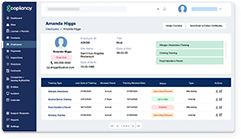
Food handler certifications can be tracked at the employee level through Copliancy’s employee management module, which automates training and integrates with HR, POS, and scheduling systems. The certifications are linked to the location’s health permit so renewal alerts include verification that supporting certifications are current.
Can general managers access health permits and inspection reports?+
Yes. Role-based access gives general managers a read-only view of their location’s current permit, recent inspection reports, and supporting documentation. When inspectors or auditors arrive, the GM produces the records immediately rather than waiting on corporate.
How does Copliancy handle pest control documentation?+
Pest control records are stored as supporting documents linked to the health permit. Recurring service records, treatment logs, and contractor certifications are all maintained in one place. When health renewals require current pest control documentation (as some jurisdictions do), the workflow knows to flag any gap.