











Grocery Store License & Permit Compliance Guide
Grocery and supermarket operators manage one of the broadest license portfolios of any industry — every store typically holds a dozen or more active licenses spanning food handling, alcohol service (where applicable), tobacco sales, lottery operations, pharmacy services (in some locations), weights and measures, and standard business operations. For multi-location grocery operators with regional or national footprints, the cumulative scale runs into thousands of active licenses. This guide explains how grocery operators manage license and permit compliance at scale and how Copliancy supports the workflow used by national grocery brands.
Grocery and supermarket operators manage broader license portfolios than almost any other industry — each store typically holds 10-20+ active licenses spanning food handling, alcohol (where applicable), tobacco, lottery, pharmacy, weights and measures, business operations, environmental permits, and more. For multi-location grocery operators, the cumulative portfolio runs into thousands of active licenses across multiple states and jurisdictions. Effective grocery compliance requires centralized tracking, jurisdiction-specific workflows, department-level granularity (pharmacy, beer/wine, deli, bakery each have separate compliance), employee certification management (food handler, alcohol service, pharmacy tech), automated renewal notifications, and audit-ready documentation. Copliancy handles all of this and is used by major grocery operators including Meijer, The Fresh Market, Lidl, Heritage Grocers, Associated Food Stores, Yesway, Allsup’s, World Market, Inconvenience, Maman NYC, and many more.
The Grocery License Portfolio
A typical grocery or supermarket location holds a diverse license portfolio. Here’s the standard universe:
City or county business operating license. Annual renewal typical. Often the foundation for all other licenses at the location.
Health department permit covering food handling, deli operations, prepared foods, and bakery. Often subject to scheduled inspections.
For stores selling alcohol. Class varies by state (off-premise vs. on-premise consumption, beer-only vs. wine vs. spirits). Renewal cycles and documentation vary significantly by state.
State and sometimes local tobacco retail licenses for stores selling cigarettes, cigars, or other tobacco products. Includes age-verification compliance.
State lottery retailer license for stores selling lottery products. Includes commission reporting requirements.
For stores with in-store pharmacies. State board of pharmacy licensing for the facility plus individual pharmacist and pharmacy technician licenses.
State or county certification of scales used in deli, produce, and bulk areas. Periodic re-certification required.
For pharmacy operations dispensing controlled substances. Federal DEA registration plus state controlled substance authorization.
For stores accepting WIC benefits. State-level authorization with periodic re-certification and inspection.
For stores accepting SNAP/EBT. Federal USDA FNS authorization.
For stores offering check cashing, money orders, or money transfers. State money services business (MSB) authorization plus federal FinCEN registration.
For grocery stores with attached fuel pumps. State and local fuel dealer licensing plus environmental permits (UST registration, stormwater).
This portfolio doesn’t include the standard layer that applies to all retail (signage permits, occupancy certificates, fire safety, FOG permits for stores with food service, environmental permits for refrigeration systems). The full universe per store can easily reach 15-25+ active records.
Jurisdictional Issues
Grocery operators expanding across markets face several jurisdiction-specific complications:
Alcohol Sales Vary Dramatically
Some states allow grocery stores to sell beer, wine, and spirits. Others restrict grocery to beer only (or beer and wine). A few states prohibit grocery alcohol sales entirely. Within states, county and city restrictions can layer in additional limits.
Lottery and Gaming Restrictions
Lottery and instant gaming rules vary by state. Some states allow grocery operators to operate as lottery retailers with relatively light requirements; others impose extensive monitoring and reporting.
Pharmacy and Healthcare Operations
State board of pharmacy rules vary significantly. Staffing requirements, prescription requirements for certain medications, and controlled substance handling all differ by state. Multi-state grocery operators with in-store pharmacies face fifty different compliance regimes.
WIC Authorization
WIC rules are administered by state agencies, and each state has its own application, re-certification, and inspection process.
Tobacco Restrictions
Some jurisdictions restrict tobacco sales to specific zones, near schools or hospitals, or to certain hours. Flavored tobacco bans add another layer of complexity.
Specialty Departments Add Their Own Compliance
Grocery operators rarely operate as monolithic stores. They include multiple specialty departments, each with its own compliance footprint:
Deli and Prepared Foods
Subject to food service-style inspection and food handler certification requirements. Some jurisdictions treat prepared foods as restaurant operations with separate permits.
Bakery
Generally covered under the broader food establishment permit, but in-store bakeries with custom cake operations may face additional licensing.
Seafood and Meat
Wet-market style operations (live seafood, custom butchering) often require additional permits. USDA inspections may apply.
Pharmacy
Operates as a separate sub-business within the store. Pharmacist-in-charge requirements, controlled substance security, prescription monitoring, and immunization authorization all add complexity.
Fuel Center
Grocery operators with fuel centers face petroleum-specific compliance: UST registration, stormwater management, vapor recovery, weights and measures for fuel dispensers.
Beer/Wine Department
Within stores that sell alcohol, the alcohol department often has its own training requirements (alcohol service certifications), age-verification compliance, and physical security requirements.
A Grocery Compliance Workflow That Scales
-
1
Inventory Every License, Every Store
For each store, document every active license — business license, food permit, alcohol license, tobacco license, lottery license, pharmacy license, WIC/SNAP authorizations, weights and measures, and any specialty department permits.
-
2
Tag Each License With Jurisdiction
City, county, state, federal — and any special jurisdictions (water districts, fire districts). Jurisdiction-specific metadata drives renewal workflows.
-
3
Configure Renewal Workflows Per License Type
Pharmacy renewals follow pharmacy-specific rules. Liquor licenses follow ABC rules. Tobacco licenses follow tobacco rules. Generic schedules don’t capture the variety.
-
4
Manage Employee Certifications Separately
Food handler cards, alcohol service certifications, pharmacy technician licenses, pharmacist licenses, money services compliance training — each tracked at the employee level with renewal notifications.
-
5
Run Cross-Store Inspections
Health inspections, weights and measures checks, lottery audits, pharmacy inspections — log every inspection across the chain so cross-store patterns surface.
-
6
Aggregate Reporting at the Corporate Level
Corporate compliance needs visibility across every store. Exception reports surface stores with recurring violations, upcoming renewals, or expired posted licenses.
How Copliancy Supports Grocery Operations
Comprehensive License Tracking
Every license category — business, food, alcohol, tobacco, lottery, pharmacy, weights and measures, WIC, SNAP, fuel, money services — is supported with structured records, renewal workflows, and document storage.
Department-Level Granularity
Specialty departments within a store can be tracked as sub-entities with their own licenses and compliance documentation. Pharmacy operations, deli operations, bakery, fuel centers each maintain their own records under the broader store.
Employee Compliance Integration
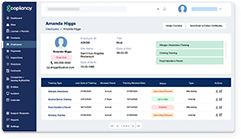
Copliancy automates employee training by directly offering mandatory training courses and integrating with existing HR, POS, and scheduling software. Food handler cards, alcohol service certifications, pharmacy technician licenses, and other employee credentials are tracked at the individual level.
Jurisdiction-Aware Workflows
Renewal timing, document checklists, and notification routing are configured per jurisdiction and per license type. Multi-state operators handle the full regulatory variety in one platform.
Bulk Operations
Bulk Update and Bulk Renewal processes save hours of work each week. Across hundreds of stores and thousands of licenses, the time savings are material.
Inspection and Violation Tracking
Every inspection — health, weights and measures, lottery, pharmacy, fuel — is logged with findings and remediation tracking. Cross-store patterns surface in aggregate reports.
Site Due Diligence and Development
For new store openings, Copliancy guides operators through site due diligence and development until each store is operational, with a standardized licensing workflow.
Contract Management
Leases, vendor contracts, distribution agreements, and licensing contracts live alongside the regulatory records.
Grocery Brands and Operators Using Copliancy
Copliancy is trusted by grocery and markets operators including: Meijer, The Fresh Market, Lidl, Heritage Grocers, Associated Food Stores, Yesway, Allsup’s, World Market, Inconvenience, Maman NYC, sweetgreen, Panda Express, Instacart, Jimmy John’s, Dunkin’, Baskin-Robbins, Krystal, Chipotle, Skims, Fabletics, Warby Parker, and many more. Multi-location grocery, market, convenience store, and specialty retail operators use Copliancy to manage license portfolios across regional and national footprints.
Frequently Asked Questions
Can Copliancy handle pharmacy compliance for grocery stores with in-store pharmacies?+
Yes. Pharmacy facility licensing, individual pharmacist and pharmacy technician licenses, DEA registration, and state controlled substance authorization can all be tracked in Copliancy. Renewal cycles for each license type are handled with their own workflows, and supporting documents (pharmacist-in-charge assignments, immunization protocols, controlled substance security) are stored with the relevant records.
How does Copliancy handle stores in states with different alcohol rules?+
Each store’s alcohol license is tagged with its issuing state and license class. State-specific renewal workflows, documentation requirements, and reporting obligations are configured per jurisdiction. A store in Indiana follows Indiana ABC rules; a store in California follows California ABC rules. Multi-state grocery operators handle the variety in one platform rather than separate tools per state.
Does Copliancy track WIC and SNAP authorizations?+
Yes. WIC state authorization and SNAP federal authorization are both tracked as separate license records with their own renewal cycles, supporting documentation, and inspection responses. Re-certification workflows are handled the same way as other license renewals.
Can Copliancy handle fuel center operations attached to grocery stores?+
Yes. Fuel dealer licenses, underground storage tank (UST) registrations, stormwater permits, vapor recovery certifications, and weights and measures for fuel dispensers can all be tracked. The fuel center can be configured as a sub-entity under the broader store, or as its own location, depending on how the operator manages it organizationally.
How does Copliancy support employee certifications across departments?+
Copliancy’s employee compliance module tracks individual certifications — food handler cards, alcohol service certifications, pharmacy technician licenses, AML training for money services, weights and measures training. Renewal alerts go to the employee and to HR. Integration with HRIS systems keeps employee data synchronized.
What if a single store sells alcohol in some hours and not others (or has multiple alcohol-related restrictions)?+
Jurisdictional restrictions and operational rules can be encoded as metadata on the license record. Some jurisdictions restrict alcohol sales to certain hours, prohibit certain product types, or impose specific physical layout requirements. These constraints are stored with the license and available for reference at the store level.