











Georgia Alcohol License Tracking & Local Compliance for Restaurant Groups
Georgia operates one of the most locally-driven alcohol licensing environments in the country. The Georgia Department of Revenue Alcohol & Tobacco Division issues state-level licenses, but most operational authority lives at the city and county level. Multi-location restaurant and bar operators in Georgia navigate state retail licenses, city or county alcohol licenses, individual pouring permits (per employee, per jurisdiction), Sunday sales authority, distance restrictions from schools and churches, and dramatically different local rules per jurisdiction. Atlanta operates one of the country’s most complex municipal alcohol licensing programs. This guide explains how multi-location operators handle Georgia compliance and how Copliancy supports the workflow.
Georgia alcohol licensing puts most operational weight on local jurisdictions. The Georgia Department of Revenue Alcohol & Tobacco Division issues state retail licenses, but cities and counties retain authority over local licenses, operating hours, density restrictions, and individual pouring permits (per employee per jurisdiction). Atlanta’s Department of Finance Office of Revenue runs one of the most complex municipal alcohol licensing programs with multiple license classes, Sunday sales considerations, and aggressive enforcement. Multi-location operators with locations in Atlanta, suburban Atlanta (Sandy Springs, Marietta, Decatur, Roswell), and outside metro Atlanta deal with dramatically different local rules per location. Distance restrictions from schools and churches vary by jurisdiction. Sunday sales are controlled by local option. Per-employee pouring permits must be renewed annually in most jurisdictions. Copliancy is used by Georgia-based and Georgia-operating multi-location operators including Buffalo Wild Wings, Outback Steakhouse, Bonefish Grill, Carrabba’s, Fleming’s, Texas Roadhouse, Applebee’s, and others.
Georgia Alcohol Licensing Structure
Georgia operates a dual-layer system that emphasizes local control:
- State Alcohol & Tobacco Division. The Georgia Department of Revenue Alcohol & Tobacco Division issues state retail licenses. State licensing is essentially a registration confirming the operator is qualified under state law.
- Local alcohol license. The actual operational license comes from the local jurisdiction — city or county. Local licenses govern hours, density, and operating conditions.
- Individual pouring permits. Most Georgia jurisdictions require individual pouring permits (sometimes called server permits or alcohol cards) per employee serving alcohol. Annual renewal common.
- Local option Sunday sales. Sunday alcohol sales are controlled at the local level. Most major jurisdictions permit Sunday sales but with specific hours restrictions.
- Distance restrictions. State law sets minimum distance requirements from schools and churches, but local jurisdictions often impose stricter rules.
- Dry/wet local option. Georgia counties can vote dry. Operators expanding into new jurisdictions must verify wet status and applicable local rules.
State vs. Local: What Each Layer Controls
Confirms qualification under Georgia alcohol law. Annual renewal. Required as foundation for any local license. Fee schedule by license class.
Operational authority from city or county. Hours of service, allowed activities, capacity limits. Renewal cycle varies by jurisdiction.
Where local option permits, Sunday sales authority is typically a separate endorsement on the local license. Hours restrictions apply.
Per-employee permit required in most jurisdictions. Annual renewal. Background check or fingerprinting required in some cities.
State minimums plus local stricter requirements. Verification required during new location due diligence.
State law sets outer limits but local rules apply. Some jurisdictions cut off at midnight; others go to 2:00 AM or later.
Pouring Permits: Per-Employee, Per-Jurisdiction
The pouring permit (sometimes called server permit or alcohol card) is Georgia’s distinctive employee-level requirement. Key features:
- Mandatory for alcohol service. Bartenders, servers, and others handling alcohol need pouring permits in most Georgia jurisdictions.
- Per-jurisdiction issuance. Permits are issued by the local jurisdiction. An Atlanta pouring permit doesn’t cover a Sandy Springs location and vice versa.
- Background or fingerprinting. Some jurisdictions (notably Atlanta) require fingerprinting and background checks for pouring permit issuance.
- Annual renewal. Most jurisdictions require annual renewal with per-employee fees.
- New hire timeline pressure. Permits often must be obtained within a short grace period after hire (typically 30-60 days).
- Per-jurisdiction recordkeeping. Documentation must be maintained per employee and produced on demand during local inspections.
Multi-location operators with employees rotating between locations across multiple jurisdictions face a particularly complex pouring permit workflow — the same employee may need separate permits for each jurisdiction where they serve.
Atlanta’s Municipal Licensing
The City of Atlanta operates one of the most complex municipal alcohol licensing programs in the South. Atlanta restaurant and bar operators typically encounter:
Full alcohol service for on-premise consumption at restaurants and bars. Annual renewal. Substantial annual fee.
Hotel alcohol service including room service. Different fee structure than restaurant licenses.
Off-premise sales for grocery, convenience, and package stores. Separate license classes for beer/wine vs. liquor.
Atlanta permits Sunday brunch alcohol service starting at 11:00 AM (rather than the historical 12:30 PM) where authorized. Operators must maintain authorization.
Hours extension to 2:30 AM available in many Atlanta zones. Additional permit and conditions apply.
Per-employee pouring permit specific to Atlanta. Requires fingerprinting and background check. Per-employee annual fee.
Atlanta’s Office of Revenue conducts enforcement including underage compliance checks, hours violations, and permit verification. Multi-location operators with Atlanta locations build dedicated workflow capacity for the city’s specific requirements.
Common Georgia Compliance Issues
State and local renewals fall on different dates. Operators focused on one miss the other. Both must be current for active operation.
Annual per-employee permits across hundreds of employees create constant churn. Without per-employee tracking, lapsed permits surface during inspection.
Employees moving between locations in different jurisdictions need pouring permits in each. Cross-jurisdiction gaps create exposure.
Sunday sales rules vary by jurisdiction. Operators sometimes operate based on assumptions rather than confirmed authority.
New school or church locations within distance restriction range can affect renewal. Periodic verification of distance compliance matters.
Atlanta and other fingerprinting-required jurisdictions can have backlog. New hires can’t serve until pouring permit is issued.
How Copliancy Handles Georgia Compliance
State DOR license and local municipal/county license tracked together per location. Both renewal dates surface in alerts.
Atlanta locations carry multiple licenses simultaneously — pouring license, Sunday brunch authorization, late-night service. Each tracked separately.
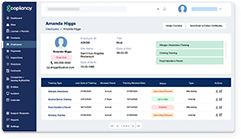
Every alcohol-serving employee tracked with pouring permits per applicable jurisdiction. Integration with HR systems keeps employee data current as people are hired and transferred.
Employees serving at multiple locations across jurisdictions tracked with separate permit records per jurisdiction. Gaps flagged before they become inspection issues.
New hires tagged with hire date and grace-period deadline. Alerts surface before deadlines so permits are obtained on time.
Local license conditions (hours, Sunday sales authority, distance compliance) documented and visible to operations.
State, local, and per-employee permit fees all flow through AP approval. Payment status visible per permit.
License certificates, pouring permit cards, fingerprint receipts, and correspondence attached to records. SharePoint and Dropbox integrations supported.
Portfolio reporting across Georgia — state and local license status, pouring permit compliance rates, upcoming renewals, and inspection patterns.
Frequently Asked Questions
Does Copliancy file Georgia alcohol applications?+
No. State DOR applications are filed through the Georgia Tax Center. Local applications are filed with the relevant city or county. Copliancy is the internal system of record — tracking applications in progress, capturing resulting licenses, scheduling renewals, and managing the lifecycle.
How does Copliancy handle pouring permit tracking across multiple jurisdictions?+
Each employee is tracked with separate permit records for each jurisdiction where they serve. Atlanta, Sandy Springs, Decatur, Roswell, Marietta, and other jurisdictions all tracked independently per employee. Integration with HR and scheduling systems keeps rosters current.
Can Copliancy handle Atlanta’s fingerprinting timeline?+
Yes. New hires in Atlanta are tagged with fingerprinting and background check status. Alerts surface delays in the background check process so operations can adjust scheduling accordingly. Documentation of completed checks attached to the permit record.
What about Sunday sales authority tracking?+
Sunday sales authority is tracked per location as either present or absent based on local rules. Where authorized, operating hours documented and visible to operations teams. Changes to local Sunday rules tracked as jurisdictional updates.
Does Copliancy support distance restriction verification?+
Yes. Distance compliance to schools and churches documented at initial licensing and re-verified periodically. Where new schools or churches open within restriction range, the system flags potential impact on renewals.
Is Copliancy used by Georgia operators today?+
Yes. Georgia-based and Georgia-operating multi-location groups including Buffalo Wild Wings, Outback Steakhouse, Bonefish Grill, Carrabba’s, Fleming’s, Texas Roadhouse, Applebee’s, and many others use Copliancy to manage their Georgia compliance.