











Compliance Software for Family Entertainment Centers, Bowling & Arcade Operators
Family entertainment centers, bowling alleys, arcades, and entertainment-dining hybrids operate one of the most diverse activity mixes in multi-location operations: arcade games, redemption games, bowling lanes, laser tag, mini-golf, ropes courses, trampolines, climbing walls, food service, alcohol service, and often event/party hosting. Each activity carries its own permitting, safety inspection, and operational requirements. Multi-location FEC operators with 5, 25, or 100+ venues face a compliance environment unlike any other in hospitality. This guide explains how FEC operators handle compliance and how Copliancy supports the workflow.
Family entertainment centers, bowling alleys, arcades, and entertainment hybrids face a compliance environment unlike any other in multi-location operations. A single venue may carry: amusement device permits (per-device in some jurisdictions), redemption game permits (with prize-value caps tracked by state), bowling lane inspection certifications, climbing structure annual safety inspections, ropes course operator certifications, trampoline park insurance and inspection requirements, food service licensing, liquor licensing (often family-friendly hours restrictions), place of public assembly certification, fire safety system inspections, and ADA compliance certifications. Equipment changes — replacing arcade games, adding new attractions, modifying climbing structures — trigger re-permitting and re-inspection. Multi-location operators with venues across multiple states navigate dramatically different rules per jurisdiction: redemption game prize-value caps range from a few dollars to hundreds depending on state. Bowling lane inspection requirements vary widely. Trampoline park requirements have evolved rapidly as the segment has matured. Centralized tracking is the only way to manage compliance across a growing portfolio. Copliancy is used by FEC and entertainment operators including Round One Bowling & Arcade, Drive Shack, Topgolf, Go Ape, Planet Hollywood, and others.
Why FEC Compliance Is Different
Family entertainment centers and bowling/arcade operators differ from standard restaurants or single-activity entertainment in structural ways:
- Diverse activity mix. A single venue might offer 8-15 distinct activities under one roof — bowling, arcade games, redemption games, laser tag, mini-golf, climbing, ropes courses, trampolines, food, alcohol, retail, party rooms. Each has its own regulatory framework.
- Per-state regulatory variation. Amusement device regulation varies dramatically by state. Some states cap redemption prize values at $5-10. Others allow much higher values. Bowling alley inspection is state-regulated in some states, not in others.
- Equipment-driven permits. Many permits attach to specific equipment. Replacing games, adding attractions, or modifying installations triggers permit work.
- Insurance overlay. Insurance carriers (for general liability, climbing/ropes liability, trampoline liability) often require inspection regimes beyond what regulators mandate. Compliance with insurance requirements is a financial necessity even where not legally required.
- Public assembly classification. FECs typically exceed public assembly thresholds, triggering elevated fire and life safety requirements.
- Child-presence considerations. Venues serving children face additional scrutiny on safety, employee background checks (in some jurisdictions), and operational standards.
Activity-Specific Permits and Licenses
Many states and cities require permits for coin/card-operated amusement devices. Permits may be per-device or per-venue. Annual renewal common.
Games that award tickets exchangeable for prizes. State-by-state caps on prize value (often $5-50). Special permitting and reporting in some jurisdictions.
State inspection of pinsetters, returns, lanes in some states. Annual or periodic inspection cycles. Equipment certification required after major repairs.
Annual professional inspection by certified climbing wall inspector. Bolt and anchor inspection. Padding and surface inspection. Insurance often requires documentation.
Per-course inspection requirements. Operator certification (ACCT or similar) required for staff. Annual inspection cycles common.
ASTM F2970 compliance requirements. State-specific requirements (notably California, Texas, New York have specific statutes). Insurance-driven inspection regimes.
Outdoor mini-golf may require zoning approval and recreation permits. Indoor mini-golf typically falls under amusement device permitting.
Equipment-specific permits in some jurisdictions. Laser device classification compliance. Operating space safety requirements.
Indoor and outdoor karting requires vehicle inspection, track safety inspection, driver age verification, and insurance compliance.
Safety Inspection Cycles
FEC safety inspections come from multiple sources: state regulators, local fire marshals, building departments, insurance carrier loss control, and the operator’s own internal safety program. Each attraction type has its own inspection cadence:
Daily and Pre-Open Inspections
Internal safety checks before opening: climbing wall padding placement, ropes course equipment, trampoline mat condition, go-kart tire pressure, arcade game function. Documented daily.
Monthly Operational Inspections
More detailed monthly checks on critical safety equipment. Fire extinguisher visual inspections. Emergency lighting checks. Padding wear evaluation. Inspection logs retained.
Quarterly Professional Service
Many attractions require quarterly service by manufacturer or certified service provider. Climbing wall hold inspection, bowling pinsetter service, ropes course component inspection.
Annual Professional Inspection
Major annual inspections by certified inspectors. Climbing wall (CWA or similar certified inspector), ropes course (ACCT-certified inspector), trampoline park (ASTM-compliant inspection), bowling alley equipment.
Regulatory Inspections
State regulator inspections (bowling alley inspection in regulated states, amusement device inspection where required), local fire marshal annual inspection, health department food service inspection.
Insurance Carrier Loss Control
Insurance carriers conduct periodic loss control visits to assess risk management practices. Findings often drive operational changes and additional documentation requirements.
Food and Beverage Compliance Within FEC
Most FECs operate food and beverage as a meaningful revenue line. Compliance requirements layer on top of activity-specific requirements:
- Food service licensing. Health department food permits for all food preparation and service. Inspection cycles per jurisdiction.
- Liquor licensing. Most FECs serving alcohol carry restaurant or tavern liquor licenses. Family-venue licensing may have additional hours restrictions or under-21 area requirements.
- Server training. State-required alcohol server training (TABC in Texas, BASSET in Illinois, RBS in California, ATAP in NY, and equivalents) per employee.
- Catering and event service. Venues hosting birthday parties, corporate events, and group functions may need additional catering or event service authorization.
- Cottage food and packaged goods. Concession-style food sales may have different requirements than full-service food.
Common Multi-Location FEC Compliance Issues
Games and attractions get swapped at locations without updating permit records. State inspectors find unpermitted equipment during routine visits.
Annual climbing wall inspections, ropes course inspections, and trampoline inspections fall behind schedule. Insurance carriers and regulators discover lapses.
Operators using same prize structures across states discover violations when state-specific prize caps are exceeded.
Ropes course operator certifications (ACCT) and climbing wall instructor certifications expire and lapse during staff turnover.
Insurance carriers require specific inspection documentation. Gaps surface at renewal when premium impact is locked in.
Injuries at attractions (climbing falls, trampoline injuries, ropes course mishaps) are high-cost claim events. Without incident-to-claim integration, documentation gaps inflate claim costs.
How Copliancy Handles FEC Compliance
Copliancy is used by FEC and entertainment operators including Round One Bowling & Arcade, Drive Shack, Topgolf, Go Ape, Planet Hollywood, and others. The platform handles FEC-specific complexity:
Climbing walls, ropes courses, bowling lanes, trampoline structures, arcade banks, mini-golf courses, go-kart tracks — each tracked as a discrete asset with its own permits, inspections, and renewal schedules.
Daily, monthly, quarterly, annual inspection cycles per attraction type with automated scheduling and vendor coordination. Photographic documentation supported.
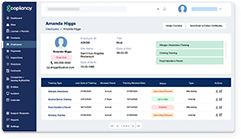
ACCT certifications for ropes course operators, CWA certifications for climbing instructors, alcohol server certifications, all tracked per employee with renewal alerts.
Games, attractions, and equipment tracked from installation through service to retirement. Permit work triggered automatically by equipment changes.
Injuries at attractions reported in Copliancy with photos, witness statements, and circumstance documentation. Critical claim documentation captured before evidence is lost.
All inspections, certifications, and incident records aggregated for insurance carrier reviews and renewals. Documentation ready when underwriters ask.
Health department permits, liquor licenses, server certifications tracked alongside attraction compliance. Single view of total venue compliance.
Specialized inspection vendors (climbing wall, ropes course, trampoline, bowling) tracked per location with service histories and contact information.
Portfolio reporting on attraction status, inspection compliance, certification rates, and incident trends. Ready for ownership, board, and insurance review.
Frequently Asked Questions
Can Copliancy track per-device amusement permits?+
Yes. Where local jurisdictions require permits per device (some cities permit each arcade game individually), Copliancy tracks devices as discrete records. Permit numbers, installation dates, fees, and renewal schedules per device.
How does Copliancy handle climbing wall and ropes course inspections?+
Climbing walls and ropes courses are tracked as attraction assets with inspection cycles (typically annual professional inspection). Inspector certifications (CWA, ACCT) verified. Inspection reports attached to the attraction record. Deficiencies tracked through remediation.
Can Copliancy handle state-by-state redemption prize cap variations?+
Yes. Each location is configured with its applicable state redemption cap. Prize structures and ticket-value-to-prize ratios tracked. Operational changes that would exceed caps in any jurisdiction get flagged.
What about trampoline park-specific requirements?+
ASTM F2970 compliance, manufacturer-specific maintenance requirements, court padding inspection cycles, court netting inspection, jumper certification (where required by carrier or jurisdiction) all tracked. Trampoline parks face the most rapidly evolving regulatory environment in FEC and tracking helps stay current.
Does Copliancy integrate with our POS or guest management systems?+
Copliancy focuses on compliance tracking rather than POS or guest management. The platform integrates with HR systems (Workday, ADP, BambooHR, Paychex), scheduling systems (Crunchtime, R365, 7shifts, HotSchedules, Deputy), and document storage (SharePoint, Dropbox). POS integration is typically not required for compliance use cases.
Is Copliancy used by FEC operators today?+
Yes. Family entertainment center, bowling, arcade, and entertainment-dining operators including Round One Bowling & Arcade, Drive Shack, Topgolf, Go Ape, Planet Hollywood, and others use Copliancy to manage their venue compliance.