











License & Permit Management for Multi-Location Assisted Living & Senior Care Operators
Multi-location assisted living, senior care, and memory care operators — including large national operators (Brookdale Senior Living, Atria Senior Living, Sunrise Senior Living, Sonida Senior Living, Five Star Senior Living, Holiday Retirement, Eclipse Senior Living, Watermark Retirement Communities, Frontier Senior Living, Cogir Senior Living, and Senior Lifestyle), regional operators with 25-200+ communities, and private-equity-backed roll-ups — face a compliance environment defined by per-state regulatory variation. State licensing agencies vary dramatically — California Department of Social Services (Community Care Licensing), Texas Health and Human Services Commission, Florida Agency for Health Care Administration (AHCA), New York Department of Health, Ohio Department of Health, Minnesota Department of Health — each with distinct licensing categories, inspection frequencies, staffing requirements, and enforcement frameworks. This guide explains how multi-location senior care operators handle compliance and how Copliancy supports the workflow.
Multi-location assisted living and senior care compliance is shaped by extreme per-state variation. Unlike nursing homes (which face uniform federal CMS oversight), assisted living and similar senior care levels are regulated almost entirely at the state level — with each state operating its own licensing agency, license categories, inspection frequencies, staff requirements, and enforcement frameworks. The licensing agency varies by state: California (Department of Social Services / Community Care Licensing), Texas (Health and Human Services Commission), Florida (Agency for Health Care Administration), New York (Department of Health), Ohio (Department of Health), Minnesota (Department of Health), Pennsylvania (Department of Human Services), Arizona (Department of Health Services), Georgia (Department of Community Health), Washington (Department of Social and Health Services). A handful of states split oversight between two agencies depending on whether facilities provide primarily social or medical services. Inspection frequencies vary — annual unannounced inspections are typical, but some states inspect biennially, and capacity constraints have led to inspection backlogs in some states reaching 12-18 months. Inspection reports are public records in every state, but formats are inconsistent and findings are not aggregated nationally like the CMS Five-Star system for nursing homes. Staff credentialing varies significantly: state-required background checks, training hour requirements, administrator/executive director qualifications, medication administration certifications, dementia care training for memory care units, CPR/first aid, and per-state continuing education. Multi-state operators learn each state’s framework separately. Copliancy supports multi-location senior care operators with per-community licensing tracking, per-staff credentialing, inspection history documentation, citation tracking, and aggregate reporting.
Senior Care Multi-Location Compliance: The Per-State Challenge
Multi-location senior care operators face compliance considerations that distinguish the segment from most other multi-site operations:
- State-by-state regulation. Unlike nursing homes, assisted living and senior care levels are regulated almost entirely at the state level. No federal preemption or harmonization across states.
- Per-state agency variation. Different states use different agencies and different licensing categories. Some states split oversight between Health and Human Services departments based on service level.
- License categories vary by state. California uses RCFE (Residential Care Facility for the Elderly), Texas uses Type A and Type B Assisted Living Facility licenses, Florida uses standard, limited nursing services, and extended congregate care. Per-state license categories require per-state operational expertise.
- Memory care additional requirements. Memory care units commonly require additional dementia training for staff, secured unit construction, additional staffing ratios, and specialized care plans.
- Heavy staff credentialing. Per-state background check requirements, training hour mandates, certifications, and administrator qualifications. Staffing complexity scales with portfolio.
- Inspection backlogs. Some state survey agencies have backlogs reaching 12-18 months, leaving facilities “current” on the books but operationally beyond their typical inspection window. AARP Public Policy Institute has documented these gaps.
- Public inspection records. Inspection reports are public records in every state, but format variation means a family researching one state finds detailed data while a different state shows sparse summary data.
- Frequent acquisitions. Senior care has been a heavily-traded segment with private equity, REITs, and consolidators driving constant acquisition activity. Acquired communities require regulatory transfer plus compliance baseline alignment.
Per-State Licensing Frameworks
Department of Social Services Community Care Licensing Division. RCFE (Residential Care Facility for the Elderly) for assisted living. Staff training, background checks, criminal record clearances, regular inspections.
Health and Human Services Commission. Type A and Type B Assisted Living Facility licenses distinguished by resident care needs. Specific staffing ratios based on resident profile.
Agency for Health Care Administration. Standard, Limited Nursing Services, and Extended Congregate Care licenses. Detailed medication administration and emergency procedures required.
Department of Health. Adult Care Facility (ACF) and Assisted Living Residence (ALR) licensing. Staff certification, facility safety standards, resident care documentation required.
Ohio Department of Health. Residential Care Facility (RCF) licensing. Staff training, resident care standards, and inspection compliance required.
Department of Health. Assisted Living Facility licensure with tiered categories. Small provider (under 11 beds) special considerations.
Department of Human Services for personal care homes. Department of Health for assisted living residences. Two-agency split common in some states.
Department of Human Services. Unannounced inspection program. Active enforcement on staffing and care plan compliance.
Department of Health Services. Assisted Living Center, Home, and Facility category distinctions. Active engagement with Arizona Assisted Living Federation of America.
Per-Staff Credentialing in Senior Care
Senior care staff credentialing is per-person and heavy:
- Background checks (multiple types). Criminal history background check, state abuse and neglect registries, sex offender registry, and in some states fingerprint-based FBI checks. Per-state renewal cycles for background checks.
- Pre-service training hours. Most states require minimum training hours before staff work with residents. Documentation maintained per staff member.
- Ongoing annual training hours. Annual continuing education required. State-specific topics including elder abuse, infection control, resident rights, dementia care.
- Medication administration. Staff administering medications require state-specific certification. Renewal cycles tracked per staff member.
- Administrator / Executive Director qualifications. Each community’s administrator carries state-required qualifications. California requires RCFE administrator certification; Texas requires Assisted Living Administrator certification.
- Memory care training. Dementia-focused training required for memory care unit staff. Annual refresher commonly required.
- CPR and first aid. Required for direct care staff. 1-2 year renewal cycles.
- Nursing oversight. Where facilities provide health-services-level care, licensed nursing staff with current state licenses required.
State Surveys, Citations, and Public Reporting
Annual unannounced inspections are the standard floor; some states inspect biennially. State survey agency capacity affects actual inspection cadence.
Resident, family, or third-party complaints trigger investigation surveys. Often unannounced. Allegations of abuse, neglect, or significant violations get priority response.
New community licensing requires pre-opening survey verifying construction code compliance, safety systems, and facility standards before residents admitted.
AARP Public Policy Institute has documented gaps in state survey capacity, with some agencies behind annual inspection schedules by 12-18 months. Facilities operating beyond their inspection window are not technically out of compliance but lack recent inspection verification.
States categorize citations by severity. Minor citations may be remediated with corrective action plans; serious citations affect license status and may trigger admission holds.
Inspection reports are public records in every state. Format and accessibility vary — some states publish detailed online databases; others provide PDFs upon request. Family review of records is common before placement decisions.
How Copliancy Handles Multi-Location Senior Care Compliance
Each community has complete records of state assisted living license, memory care endorsement (where applicable), licensed capacity, certificate of occupancy, fire safety, and applicable specialty endorsements.
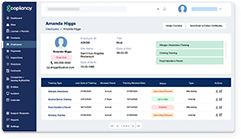
Every staff member tracked with background checks (all required types), pre-service training, ongoing training hours, medication administration certifications, CPR/first aid, and dementia training where applicable.
Administrator and Executive Director roles tracked per community with state-required qualifications documented. Vacancies flagged for state notification compliance.
Per-state requirements documented. Multi-state operators see per-state credentialing standards. Staff transferring between states have credentials tracked per state framework.
Inspections per community tracked with findings, citations, severity, and remediation status. Aggregate trends across communities identify systemic operational issues.
Citations and corrective action plans tracked with deadlines and ownership assignments. Remediation documentation centralized. Compliance officers ensure plans complete on time and surveys verify remediation.
Memory care unit certifications, secure unit documentation, dementia training compliance, and specialized care plans tracked alongside general community compliance.
When acquiring communities, integration workflows inventory state licensing, staff credentials, inspection history, and licensed capacity. State regulatory approval timelines tracked through closing.
Portfolio reporting across senior care operations — license status by state, staff credential compliance, inspection trends, citation patterns, occupancy and licensed capacity. Ready for ownership, board, and REIT/lender review.
Frequently Asked Questions
Does Copliancy file state senior care license applications?+
No. State applications and renewals are filed by the operator or licensing counsel directly with each state agency. Copliancy is the internal system of record — tracking applications in progress, capturing resulting licenses, scheduling renewals, and managing the lifecycle.
How does Copliancy handle multi-state credentialing?+
Each staff member tracked with credentials per state where they work. Multi-state operators see per-state requirements (different background check types, training hour mandates, administrator qualifications) applied appropriately. Integration with HR systems keeps staff rosters current.
Can Copliancy track inspection history and citations?+
Yes. Inspections per community tracked with findings, citations, severity, and remediation. Corrective action plans tracked with deadlines and remediation documentation. Aggregate citation patterns across communities identify systemic operational issues.
What about memory care units?+
Memory care endorsements, secure unit documentation, dementia training compliance, specialized care plans, and additional staffing requirements all tracked alongside general community compliance. State-specific memory care frameworks documented per community.
Does Copliancy support acquisition integration?+
Yes. When acquiring communities, integration workflows inventory state licensing, staff credentials, inspection history, and licensed capacity. State regulatory approval timelines tracked through closing. Post-close integration to acquirer compliance baseline routed through structured workflows.
Is Copliancy used by senior care operators today?+
Multi-location operators in assisted living, senior care, and memory care face compliance challenges similar to other heavily-regulated multi-state operations. Copliancy’s flexible architecture supports senior care operations including per-community licensing, per-staff credentialing, inspection management, and aggregate reporting.