











License & Permit Management for Multi-Location Gym & Fitness Studio Operators
Multi-location gym and fitness studio operators — from large national chains and franchisees of Planet Fitness, Crunch, Anytime Fitness, Orangetheory, and Pure Barre, to regional boutique studio operators — face a deceptively complex compliance environment. State-level health studio or fitness facility registrations (where required), per-location business licenses, certificates of occupancy, fire safety inspections, swimming pool permits (for facilities with pools), per-trainer certifications, and labor law compliance multiply across the portfolio. Florida and several other states maintain specific health studio acts requiring annual per-location registration. This guide explains how multi-location fitness operators handle compliance and how Copliancy supports the workflow.
Multi-location gym and fitness studio operators face a compliance environment that’s often underestimated until growth crosses 25-50 locations. State health studio or fitness facility acts in states like Florida require per-location annual registration. Florida’s Health Studio Act, administered by the Department of Agriculture and Consumer Services (FDACS), charges a $300 annual registration fee per location — meaning a 50-location Florida operator pays $15,000 annually just for state health studio registration before any other fees. Per-location business licenses, certificates of occupancy, fire safety inspections, sign permits, sales tax registrations, and zoning compliance multiply across the portfolio. Facilities with swimming pools, hot tubs, or spa services need additional state or county health department permits. Some jurisdictions require certified pool operators on staff. Personal trainer certifications (NSCA, ACE, NASM, ACSM) are tracked per trainer. Some states require nutrition counseling licensing for trainers providing dietary advice. Franchisee operators face additional franchisor brand standards compliance. National brands operating across multiple states deal with significant per-state variation in requirements. Copliancy supports multi-location fitness operators with per-location permit tracking, per-trainer certification management, pool compliance documentation, new location opening workflows, and aggregate reporting for ownership and franchisor review.
Fitness Operator Compliance: Why It Matters
Multi-location fitness operations share characteristics with other retail multi-site businesses but have distinct considerations:
- Per-state health studio acts. Several states (Florida prominent among them) maintain specific health studio or fitness facility acts requiring per-location annual registration with the state.
- High location density. Major fitness operators run 25-2,000+ locations. National franchise chains have thousands of locations across hundreds of franchisees.
- Franchisee operator structure. Many fitness operations are franchisees of national brands. Franchisee operators with 25-200+ locations face the same multi-site compliance challenges as independent chain operators.
- Pool and spa compliance. Facilities with pools, hot tubs, or spas face state or county health department oversight including certified operator requirements, chemical testing logs, and signage requirements.
- Trainer credentialing. Personal trainers and group fitness instructors carry per-person certifications (NSCA, ACE, NASM, ACSM, others) with renewal cycles. Some states require additional licensing for nutrition counseling.
- Member-services labor law overlay. Member services staff, trainers, and front-desk employees fall under wage-and-hour, classification, and overtime rules with state variations.
- Sales tax variation. Member fees, personal training, retail merchandise, and food/beverage sales each face state-specific tax treatment. Some states tax fitness membership; others don’t.
Permit Categories Multi-Location Fitness Operators Track
In states with health studio acts (Florida and others), annual per-location registration required. Florida charges $300 per location annually through FDACS.
City or county business license per location. State sales tax registration where applicable. Annual renewal cycles per jurisdiction.
Required from city or county building department. Capacity, layout, and use category all reflected in CO. Modifications affecting capacity or use trigger CO updates.
Verification that the location is zoned for fitness facility use. Particularly important for new openings and locations in mixed-use developments.
Annual fire safety inspections by local fire marshal. Egress, sprinklers, fire extinguishers, occupancy limits all part of inspection.
Exterior signage, monument signs, and interior signage. City sign permits required separately.
For facilities with swimming pools, state or county health department pool permits. Annual renewal. Certified pool operator on staff required in most states.
Hot tubs and spas require separate health department permits in many jurisdictions. Temperature regulation, sanitation, and water replacement schedules documented.
Many states require AED (automated external defibrillator) registration with local EMS, regular maintenance certification, and staff CPR/AED training documentation.
State Health Studio Acts and Per-Location Registration
Florida’s Health Studio Act provides a representative example of state-specific health studio regulation:
- FDACS administration. The Florida Department of Agriculture and Consumer Services administers the Health Studio Act. Health studios — defined broadly to include gyms, boxing studios, fitness facilities, and similar concepts — must register with FDACS.
- $300 annual fee per location. Each health studio location pays $300 annually. Multi-location operators pay per-location regardless of common ownership.
- 15-business-day processing. Standard FDACS processing time. Notice of Deficiency within 30 days if application is incomplete; 30 days to respond before denial.
- Broad definition of “health studio.” Includes any person selling services for instruction, training, or assistance in a program of physical exercise, or the right or privilege to use equipment or facilities for physical exercise. (Individual personal trainers excluded.)
- Security/bond requirements where applicable. Florida health studios that take prepaid sales (pre-opening sales or installment payment contracts above defined thresholds) must post a security instrument — commonly a $50,000 surety bond per the current FDACS form. A reduced bond amount may apply where outstanding contracts stay below specified thresholds and member lists are filed annually. Security may also be posted as an irrevocable letter of credit or a certificate of deposit guarantee agreement in lieu of a bond, subject to FDACS approval.
- Membership contract requirements. FDACS regulates the form and content of health studio membership contracts including cooling-off period requirements.
Other states with notable health studio or fitness facility regulations include New York, California (specific to prepaid contracts), Maryland, and Massachusetts. Each state’s requirements differ; multi-state operators learn each.
Multi-State Fitness Operator Issues
Florida’s $300 annual per location differs from other state requirements. Multi-state operators learn each state’s specific framework and renewal cycles.
Facilities with pools face state or county health department compliance including certified pool operators, chemical testing, and signage. Brands with mixed pool / non-pool locations track variability.
NSCA, ACE, NASM, ACSM, and other certifications carry renewal cycles. Brands may require specific certifications from their trainers; verification per hire and per renewal matters.
New gym openings require coordinated work on health studio registration, business license, CO, fire safety, zoning, sign permits, and AED registration. Without coordination, openings get delayed.
Acquired locations arrive with incomplete documentation and inconsistent compliance baselines. Integration workflows matter for franchisee operators consolidating territories.
National franchise brands audit franchisee operations. Compliance documentation must be available for audit including trainer certifications, equipment maintenance, and AED status.
How Copliancy Handles Multi-Location Fitness Compliance
Each location has complete records of state health studio registration (where applicable), business license, certificate of occupancy, fire safety inspection, sign permits, pool permits, and AED registration.
Florida FDACS Health Studio Act and similar state programs tracked per location with annual renewal dates and per-location fees. Membership contract compliance documented.
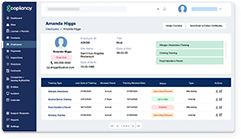
Each trainer tracked with certifications (NSCA, ACE, NASM, ACSM, or others) and renewal dates. Integration with HR systems keeps employee rosters current. Brand-required certifications enforced.
Where pools or spas are present, certified pool operator on staff tracked, chemical testing logs maintained, and state or county health department permits renewed on cycle.
AED registration with local EMS, maintenance certifications, and per-employee CPR/AED training tracked. Documentation ready for state and franchisor inspections.
New gym openings tracked through coordinated permit work — CO, health studio registration, fire safety, business license, sign permits — with critical path visibility to opening day.
When acquiring locations or territories, integration workflows inventory existing compliance, identify gaps, and route remediation. Acquired locations reach standardized baseline through structured workflows.
State health studio fees, business license fees, pool permits, sign permits, and AED service fees flow through AP approval. Payment status visible per permit.
Portfolio reporting across all locations — health studio registration status, trainer certification compliance, pool compliance, new opening progress. Ready for ownership and franchisor review.
Frequently Asked Questions
Does Copliancy work for franchisee fitness operators?+
Yes. Franchisee operators with 25-200+ locations have the same compliance needs as corporate operators. Copliancy supports franchisee operations including franchisor-required compliance documentation. Franchisor read-only access configurable where required by brand agreements.
How does Copliancy handle Florida’s Health Studio Act?+
Each Florida location is registered with FDACS at $300 annually with renewal dates tracked. Where security/bond requirements apply (for studios taking prepaid sales above defined thresholds), surety bond, letter of credit, or CD guarantee documentation maintained alongside the registration record. Membership contract compliance documentation maintained per location.
Can Copliancy track personal trainer certifications?+
Yes. Each trainer tracked with certifications (NSCA, ACE, NASM, ACSM, or others), issue dates, and expiration dates. Integration with HR systems keeps trainer rosters current as people are hired and transferred.
What about pool compliance for fitness facilities with pools?+
Pool permits tracked per location with annual renewals. Certified pool operator on staff documented. Chemical testing logs maintained. State or county health department compliance ready for inspection.
Does Copliancy support new location opening workflows?+
Yes. New location openings often involve 6-12 permits and approvals. Coordinated workflows track health studio registration, business license, CO, fire safety, sign permits, and AED registration with critical path visibility to opening day.
Is Copliancy used by fitness operators today?+
Multi-location operators in fitness and wellness segments including franchisee operators and independent regional chains use Copliancy’s flexible architecture to manage per-location compliance, trainer credentialing, and aggregate reporting.