











Massachusetts ABCC License Management for Bars, Restaurants & Package Stores
Massachusetts operates a notable dual-layer alcohol licensing system administered by the state Alcoholic Beverages Control Commission (ABCC) and local Licensing Boards or selectmen. The state caps liquor licenses by municipality based on population, creating a secondary market where licenses trade for $200,000 to $500,000+ in Boston, Cambridge, and other dense markets. Multi-location operators in Massachusetts navigate quota constraints, dual-layer approval requirements (local board first, then ABCC), TIPS or equivalent server training, annual renewals at both layers, and notable per-municipality variation in rules. This guide explains how multi-location operators handle Massachusetts compliance and how Copliancy supports the workflow.
Massachusetts alcohol licensing combines state Alcoholic Beverages Control Commission (ABCC) authority with substantial local Licensing Board power, creating a true dual-approval system. Liquor licenses are quota-capped by municipality based on population, making them scarce assets in dense markets. Boston, Cambridge, Somerville, Brookline, and other Greater Boston jurisdictions see license values of $200,000-$500,000+ in the secondary market. Every new application requires local Licensing Board approval first, then ABCC approval — a process that can take 4-12 months from initial application to active license. Annual renewals run through both layers. Multi-location operators with 5-50+ Massachusetts locations face overlapping local board cycles (each city or town runs its own calendar), TIPS or equivalent server training tracked per employee, and Boston-specific requirements including health inspection grade postings. Copliancy supports Massachusetts operators with per-location dual-layer tracking, per-employee server certification, payment tracking with AP integration, and aggregate visibility for ownership and counsel review.
Massachusetts ABCC and Local Licensing Structure
Massachusetts operates a dual-authority structure that distinguishes it from most other states:
- State ABCC oversight. The Alcoholic Beverages Control Commission is the state regulatory body. ABCC issues final licenses, regulates manufacturers and wholesalers, and enforces statewide rules.
- Local Licensing Boards. Each city or town operates its own Licensing Board (or Board of Selectmen in smaller towns). Local boards have substantial authority over license approval, conditions, hours, and renewal.
- Quota-capped licenses. All-alcoholic licenses are capped per municipality based on population (typically 1 per 1,000 residents for restaurants, fewer for package stores). Most desirable jurisdictions are at quota.
- Secondary market pricing. Quota constraints create high secondary-market values — $200,000-$500,000+ for Boston, Cambridge, Somerville restaurant licenses; lower but still substantial in other dense markets.
- Three-year terms (or annual). Some municipalities issue licenses with three-year terms but most still require annual renewal review.
- TIPS or equivalent training. Server training required statewide. TIPS is the most common certification but other state-approved programs qualify.
Massachusetts License Classes
Full liquor service for on-premise consumption at restaurants meeting food service requirements. Annual renewal. Quota-limited per municipality.
Wine and beer service only (no spirits) at restaurants. Less restricted quota in many municipalities. Lower fee than all-alcoholic.
Hotels and inns with required minimum room counts and food service. Allows alcohol service for guests including room service.
Private clubs serving members only. Different operational restrictions and reporting requirements.
Retail sales for off-premise consumption. Quota-limited per municipality. Higher secondary-market values than restaurant licenses in some markets.
Beer and wine retail only (no spirits). Common for convenience stores and grocery operations.
Veterans organizations and fraternal groups operating under different rules. Member-only service.
Temporary licenses for events. Available to non-profits and others for specific date/event combinations.
The Dual-Layer Approval Process
Every Massachusetts license application moves through both local and state review:
Local Licensing Board Filing
Application is filed with the local Licensing Board (or Board of Selectmen). Includes lease, financials, plans, operating proposal, and required filings. Application fee paid to municipality.
Local Hearing
Public hearing scheduled by the local board. Notice published. Opportunities for opposition (abutters, residents) to be heard. Hearing may include neighborhood input, business plan presentation, and operational conditions negotiation.
Local Approval With Conditions
Local board approves (or denies) the application. Approvals typically come with conditions — closing hours, entertainment restrictions, capacity limits, food service requirements. These follow the license through renewals.
ABCC Filing
Local approval and full application package forwarded to ABCC. ABCC conducts background investigation, source-of-funds review, and verifies eligibility under state law.
ABCC Approval
ABCC issues final license. Local-imposed conditions are recorded with the license. Operations may commence after ABCC issuance and posting of required signage.
Annual Renewal Through Both Layers
Each year the license must be renewed through the local board first, then ABCC. Local board renewal fee paid; conditions may be modified at renewal. ABCC renewal fee paid. Both layers must complete before license year-end.
Total timeline from initial application to active license typically runs 4-12 months. Operators planning Massachusetts expansion must account for this in opening schedules.
TIPS Training and Server Certification
Massachusetts requires server training for employees handling alcohol, with TIPS (Training for Intervention ProcedureS) being the most widely used program. Key features:
- Statewide requirement. All employees serving alcohol must complete state-approved server training.
- Multiple approved programs. TIPS is most common but several other programs are state-approved.
- Per-employee documentation. Certifications maintained per employee with issue date and expiration.
- Typically three-year cycle. Most certifications valid for three years before renewal required.
- Mitigation in disciplinary cases. Documented server training can serve as mitigating evidence in cases of underage sales or over-service citations.
- Insurance benefit. Many liquor liability insurance carriers offer premium reductions for documented server training programs.
Common Massachusetts Compliance Issues
Operating hours, food service requirements, entertainment restrictions from initial approval get forgotten over time. Renewal reviews surface violations.
Operators complete local renewal but miss ABCC renewal (or vice versa). Both must be current for active operation.
Three-year cycles spread across hundreds of employees create constant churn. Without per-employee tracking, lapses surface during inspection or claim review.
Operators planning new locations discover late that target municipality has no available quota. Acquisition through secondary market or surrender is the only path.
Changes to operations (extended hours, added entertainment) require returning to local board for condition modifications. Without tracking, operators expand operations without proper approval.
License transfers run through both local board and ABCC. Process can take 6-9 months. Acquisitions planned without accounting for transfer time face delays.
How Copliancy Handles Massachusetts Compliance
State ABCC license and local municipal license tracked together per location. Both renewal dates surface in alerts. Both fees flow through AP.
Conditions from initial local board approval (hours, food service, entertainment) documented and visible to operations teams. Changes to operations flagged against conditions.
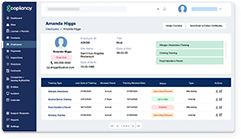
Each alcohol-serving employee tracked with server certification, expiration date, and program (TIPS or equivalent). Integration with HR systems keeps employee data current.
Per-municipality quota status documented. New location due diligence informed by current quota availability. Expansion planning accounts for quota constraints.
License transfers tracked through local board and ABCC approval with milestone dates. Critical path visibility for acquisition planning.
Proposed changes to operations (hours, entertainment, capacity) tracked through local board re-approval. Documentation supports the modification request.
State and local renewal fees flow through AP approval. Both layers visible per location. Eliminates partial renewal completion.
License certificates, local board approvals, conditions, TIPS certificates, inspection reports attached to records. SharePoint and Dropbox integrations supported.
Portfolio reporting across Massachusetts — license status by municipality, TIPS compliance rates, condition compliance, and upcoming renewals.
Frequently Asked Questions
Does Copliancy file local board or ABCC applications?+
No. Local board applications are filed with the relevant Licensing Board. ABCC applications are filed through the ABCC portal. Copliancy is the internal system of record — tracking applications in progress, capturing resulting licenses, scheduling renewals, and managing the lifecycle.
How does Copliancy handle the dual-layer renewal?+
Each location is configured with both local board renewal cycle and ABCC renewal cycle. Alerts surface for both. The system tracks each as a distinct compliance event so partial renewal completion (local done, ABCC missed, or vice versa) is visible.
Can Copliancy track local board conditions on licenses?+
Yes. Conditions imposed at initial approval (hours, food service requirements, entertainment restrictions, capacity limits) documented per license. Operations changes that conflict with conditions get flagged. Modification workflows support returning to local board for changes.
What about license transfers?+
License transfers tracked from purchase agreement through local board approval and ABCC approval. Timeline (typically 6-9 months) visible for acquisition planning. Deposits, contingencies, and milestone dates documented.
Does Copliancy show quota status by municipality?+
Yes. Per-municipality quota information documented and updated as conditions change. New location due diligence informed by current quota availability. Expansion planning accounts for whether new licenses are available or whether secondary-market acquisition is required.
Is Copliancy used by Massachusetts operators today?+
Yes. Multi-location operators with Massachusetts operations including restaurant groups and hospitality operators use Copliancy to manage their Massachusetts compliance alongside broader multi-state operations.