











Construction Contractor License Management: Complete Guide
Construction contractors operating across multiple states face one of the most fragmented license environments in any industry. Every state has its own contractor licensing rules — license classes, examination requirements, bonding, insurance, financial disclosures, and renewal cycles all differ. Within each state, individual cities and counties layer in their own contractor registration and permit requirements. For multi-state contractors, the cumulative complexity is substantial. This guide explains how multi-state contractors manage license compliance and how Copliancy supports the workflow used by construction operators and real estate development organizations.
Construction contractor license management is uniquely complex because every state writes its own contractor licensing rules — license classes, examination requirements, qualifying party requirements, bonding minimums, insurance minimums, and renewal cycles all differ. Cities and counties within each state add additional contractor registration requirements and project-specific permits. For multi-state contractors, the cumulative portfolio includes state contractor licenses (per state), trade-specific licenses (electrical, plumbing, HVAC, etc.), city/county contractor registrations, project-specific building permits, bonding agreements, insurance certificates, and supporting financial documentation. Effective contractor compliance requires centralized tracking across all license types and jurisdictions, automated renewal workflows, project-specific permit tracking with timeline integration, bonding and insurance renewal automation, and aggregate corporate visibility. Copliancy supports this workflow with its license and permit management platform, contract management, and project tracking — used by construction and real estate operators including multi-state general contractors, specialty trade contractors, and real estate development organizations.
The Construction License Landscape
Construction contractor licensing isn’t governed by a single federal framework — it’s a patchwork of state and local rules. Each state’s contractors’ state licensing board (CSLB in California, RMLO in Texas, etc.) writes its own rules covering:
- What license classes exist (general contractor, residential, commercial, specialty trades)
- What examinations qualifying parties must pass
- What bonding and insurance minimums apply
- What financial disclosures are required
- What renewal cycles and continuing education requirements apply
- What reciprocity (if any) exists with other states
Below the state layer, cities and counties typically require contractor registration before permits can be pulled for projects within their jurisdiction. A general contractor working on a project in Houston needs the City of Houston contractor registration on top of the state Texas Residential or Commercial license.
Below the contractor licensing layer, every project triggers its own permits: building permits, electrical permits, plumbing permits, mechanical permits, demolition permits, grading permits, and site development permits. Each has its own application process, fee, inspection schedule, and finalization requirements.
License Classes Vary by State
What “general contractor” means depends entirely on which state you’re operating in:
A (general engineering), B (general building), and 40+ C-classifications for specialty trades. Examination required for qualifying party.
No state-level general contractor license. Residential builders register with the TRCC. Electrical, plumbing, HVAC, and certain trades licensed at state level. General contractors register at city level.
Certified or Registered contractor licenses. Multiple license divisions (General, Building, Residential). Specialty trades licensed separately.
No state-level general contractor license. NYC requires licensing through Department of Consumer and Worker Protection. Other localities have their own rules.
Electrical, plumbing, HVAC, mechanical, and a few other trades are licensed at the state level in nearly every state. Standards and exams vary.
Some states recognize licenses from other states (reciprocity agreements). Most don’t, or only partially. Multi-state contractors must license individually in each state.
For multi-state contractors, this means maintaining detailed knowledge of every state where the company operates, plus the local registration requirements within those states. The compliance portfolio is large and inherently fragmented.
Project-Specific Permits
Contractor licensing authorizes the company to bid and contract. Project permits authorize specific work at specific locations. Every project requires its own permit set:
Building Permit
Issued by the building department. Required before construction can start. Application typically requires architectural plans, structural calculations, energy compliance documentation, and site plans.
Trade Permits
Electrical, plumbing, mechanical, and similar trade permits are typically separate from the building permit. Each trade contractor pulls their own permit and schedules their own inspections.
Specialty Permits
Demolition permits, grading permits, sign permits, and other specialty work each require their own permits.
Environmental Permits
Stormwater discharge (NPDES), wetlands, air quality, and other environmental permits apply to certain project types.
Inspection Sequencing
Permits don’t just need to be pulled — they need to be passed through inspection at each stage. Footing, framing, rough-in, final — each inspection must be completed before the next phase can proceed. Missed or failed inspections delay projects directly.
Certificate of Occupancy
After all inspections pass, the certificate of occupancy authorizes the building to be used. For commercial projects opening on a specific date, this is the gating item.
Bonding and Insurance Requirements
Beyond licensing, contractors must maintain bonding and insurance — and both have their own renewal cycles independent of license renewals.
License Bond
Most states require a contractor license bond as a condition of licensing. Bond amounts vary by state and license class. Bonds typically renew annually, and a lapsed bond can suspend or invalidate the underlying license.
Project Bonds
For specific projects (especially public projects), additional bonding may be required: performance bonds, payment bonds, bid bonds. Each project’s bonding is separate.
General Liability Insurance
Required by states for license issuance, and required by project owners contractually. Minimum coverage amounts vary by jurisdiction and project.
Workers’ Compensation
Required in every state for businesses with employees. Independent contractor classifications add complexity.
Commercial Auto Insurance
For contractors operating company vehicles.
Inland Marine / Equipment Insurance
For contractors with significant equipment investments.
A Contractor License Tracking Workflow
-
1
Inventory Every License and Registration
Document every state contractor license, trade license, city/county registration, and any specialty authorizations. Tag with issuing authority, license class, expiration date, and renewal requirements.
-
2
Track Qualifying Party Requirements
Most state contractor licenses require a designated qualifying party (the individual who passed the examination). If the qualifying party leaves the company, the license is at risk. Track qualifying party assignments and renewal-driven continuing education requirements.
-
3
Manage Bonding and Insurance Separately
License bonds, project bonds, GL insurance, workers’ compensation, and other policies each renew independently. Track each as a separate record with its own renewal cycle.
-
4
Maintain Project Permit Tracking
Every active project has its own permit set. Track permits, inspection schedules, finalization status, and certificate of occupancy timing per project.
-
5
Automate Renewal Notifications
Multi-stage notifications at 90, 60, 30, and 7 days before expiration cover licenses, bonds, insurance, and registrations.
-
6
Centralize Supporting Documentation
Financial statements, qualifying party documentation, examination results, continuing education records, bond riders, insurance certificates — all stored in one platform.
How Copliancy Supports Construction Contractors
License and Registration Tracking
State contractor licenses, trade-specific licenses, city/county contractor registrations, and specialty authorizations are all tracked as structured records with renewal workflows.
Qualifying Party Tracking
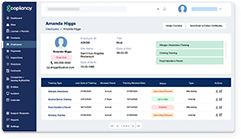
The individual qualifying party for each state license can be tracked through Copliancy’s employee compliance module. Examination credentials, CE requirements, and continuing certification status are managed at the individual level.
Bonding and Insurance Records
License bonds, project bonds, GL insurance, workers’ compensation, commercial auto, and other policies are stored as records with their own renewal cycles. Renewal alerts fire independently of license renewals.
Project Permit Tracking
For each active project, permits can be tracked with inspection schedules, finalization status, and certificate of occupancy timing. Copliancy guides companies through the due diligence and development of new projects until they are operational.
Contract Management
Construction contracts, subcontractor agreements, lien waivers, change orders, and project documentation live alongside the license and permit records.
Inspection and Violation Tracking
Project inspections, OSHA inspections, code enforcement inspections, and other on-site reviews are logged with findings and remediation tracking.
Equipment and Repair Management
Construction equipment, vehicle fleets, and tool inventories can be tracked with preventive maintenance schedules and repair history.
Incident Reporting and Insurance Claims
Workplace incidents, vehicle incidents, property damage, and other events trigger incident reports integrated with insurance claims workflows.
Multi-State Visibility
Corporate compliance teams have aggregate visibility across every state, every project, and every license. Exception reports surface upcoming renewals and at-risk records.
Frequently Asked Questions
Does Copliancy handle reciprocity tracking between states?+
Where states have reciprocity agreements that allow license recognition from other states, those relationships can be encoded as metadata on the license records. The underlying registration in each individual state is still tracked, but reciprocity context helps the compliance team understand which licenses unlock work in additional states without separate application.
Can Copliancy track project-level permits separately from contractor licenses?+
Yes. Project permits are typically tracked as time-bounded records tied to specific projects rather than to the broader company. Each project’s permit set — building permit, trade permits, environmental permits — is maintained with its own inspection schedule, finalization status, and certificate of occupancy timing.
How does Copliancy handle qualifying party requirements?+
Most state contractor licenses require a designated qualifying party who passed the examination. If the qualifying party leaves the company, the license is at risk. Copliancy tracks qualifying party assignments at the license level and integrates with employee records so qualifying party departures generate compliance alerts.
Does Copliancy track bonding and insurance renewals?+
Yes. License bonds, project bonds, GL insurance, workers’ compensation, commercial auto, and other policies are each tracked as separate records with their own renewal cycles. Renewal alerts fire independently of license renewals because the cycles often don’t align.
Can Copliancy handle multi-state contractor operations?+
Yes. Each state’s contractor licensing is tracked with state-specific renewal workflows, documentation requirements, and continuing education tracking. Multi-state contractors handle 50-state regulatory variety in one platform rather than maintaining separate tools per state.
Does Copliancy support real estate development organizations as well as contractors?+
Yes. Real estate development organizations face overlapping compliance with construction contractors: state licensing, project permits, environmental permits, zoning, occupancy. Copliancy is optimized for real estate and construction operators, including national real estate development organizations managing multi-state project portfolios.